
Which Following Best Describes Pan-Arabism?
If you’re wondering what pan-Arabism is, it’s an ideology that unites Arab countries through shared language, culture, and history. Pan-Arabism promotes Arab nationalism, political unity, and resistance against foreign control. It emphasizes cooperation, independence, and pride in Arab identity rather than just politics or military power.
This ideology has shaped Middle East politics in lasting ways. By exploring further, you’ll uncover its key leaders, goals, and ongoing impact.
Pan-Arabism remains a significant force in the region’s social and political landscape.
What Is Pan-Arabism and Its Core Principles?
What drives the Pan-Arabism movement? It’s the powerful desire for Arab unity, rooted in a shared identity across Arab countries. You’ll see it’s a political movement that emphasizes Arab nationalism, focusing on your common language, history, and cultural pride.
Emerging in the early 20th century, Pan-Arabism calls for independence from foreign control and encourages regional cooperation among Arab peoples. This movement isn’t just about politics; it’s about strengthening your ties and pride in being Arab.
Leaders like Gamal Abdel Nasser championed these ideas, promoting solidarity that transcends borders. By embracing Pan-Arabism, you connect with a vision that unites diverse peoples through cultural pride and a collective fight for independence, making it a defining force for the Arab world today.
How Did Pan-Arabism Originate and Develop Historically?
How did Pan-Arabism take shape amid a changing world? You see, as the Ottoman Empire declined, Arab nationalism emerged, fueled by a growing desire for independence from European colonialism. This movement aimed at Arab unity across the Middle East, pushing Arab states toward regional integration.
Arab leaders inspired many through the Arab revolts during World War I, which showcased the collective spirit against foreign domination. By 1945, the formation of the League of Arab States formalized this drive for cooperation. Efforts like the brief United Arab Republic between Egypt and Syria highlighted political ambitions to solidify Arab unity.
Throughout this period, Pan-Arabism developed as both a cultural and political force, shaping the identity and aspirations of Arabs seeking sovereignty and solidarity.
Who Were the Key Leaders of Pan-Arabism?
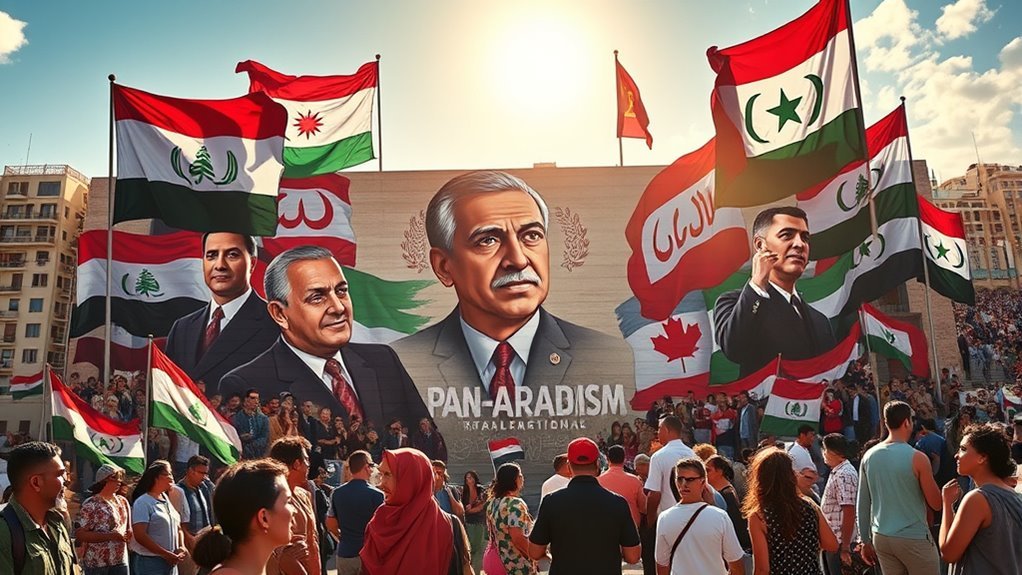
You’ll want to focus on key figures like Gamal Abdel Nasser and Michel Aflaq, who shaped Pan-Arabism’s political and ideological foundations. Their visions for Arab unity and independence defined the movement’s direction throughout the 20th century.
Understanding their roles helps you grasp how Pan-Arabism grew into a powerful force across the Arab world.
Influential Pan-Arab Figures
Who shaped the vision of Pan-Arabism and drove its momentum across the Arab world? You can’t overlook Gamal Abdel Nasser, Egypt’s charismatic leader who championed Arab unity and led the United Arab Republic with Syria. Then there’s Michel Aflaq, a Syrian philosopher who co-founded the Baath Party, promoting Arab socialism and cultural unity.
Zaki al-Arsuzi, another Syrian nationalist, deeply influenced Baathist ideology, emphasizing language and cultural identity as pillars of Arab nationalism. These Arab leaders fueled Pan-Arabism’s rise across the Middle East, pushing for Arab independence and solidarity. Alongside them, figures like Suleiman Frangieh supported Arab nationalism, strengthening the movement.
You see, these influential Pan-Arab figures shaped a collective identity, aspiring for lasting Arab unity and independence in a region marked by colonial legacies and division.
Ideological Foundations
Although Pan-Arabism drew strength from many sources, its ideological foundation was shaped by a handful of key leaders who championed Arab unity through shared language, culture, and anti-imperialist ideals. You’ll find Gamal Abdel Nasser at the forefront, promoting Arab nationalism and Arab independence during the 1950s and 1960s.
Michel Aflaq, the Syrian philosopher and Baath Party founder, emphasized Arab culture and socialist principles to strengthen the Arab movement. Zaki al-Arsuzi contributed substantially to Arab cultural revival, shaping Baathism’s core ideas.
Meanwhile, Sati al-Husri underscored the importance of the Arab language and shared identity for uniting Arabs. Together, these leaders forged Pan-Arabism’s ideological backbone, uniting people around Arab culture, language, and the goal of resisting imperialism for Arab independence.
What Are the Core Goals of Pan-Arabism?
You want to understand how Pan-Arabism pushes for Arab nationalism and unity across the region. It encourages cooperation among Arab countries in politics, economics, and culture while aiming for independence from outside control.
Let’s explore how these core goals shape the movement’s vision.
Arab Nationalism Promotion
Why does Pan-Arabism matter to you? Because it champions Arab nationalism and promotes Arab unity, giving you a shared identity rooted in language, culture, and history. This political movement pushes for Arab solidarity and cultural cooperation among Arab countries, aiming for regional independence and freedom from foreign control and colonialism.
| Core Focus | Purpose | Impact |
|---|---|---|
| Arab nationalism | Foster a shared identity | Strengthened Arab solidarity |
| Arab unity | Enhance cooperation | Political and economic growth |
| Anti-colonialism | Achieve independence | Reduced foreign influence |
| Cultural cooperation | Promote common heritage | Unified regional identity |
Unity Among Arab Nations
When Arab nations unite around their shared language, culture, and political goals, they strengthen a collective identity that Pan-Arabism champions. You see, the core goals of this Arab movement focus on fostering Arab nationalism and promoting Arab unity among Arab countries. By emphasizing cultural unity and shared identity, it encourages political cooperation and regional solidarity.
This unification aims to overcome divisions, creating a stronger, more cohesive Arab world. Pan-Arabism also stresses independence from external control, ensuring that Arab countries govern themselves without foreign influence. As you engage with this movement, you recognize its commitment to building a future where Arab nations collaborate politically and culturally, reinforcing their common heritage and aspirations for a united and independent Arab region.
Cooperation And Independence
How does Pan-Arabism aim to unite Arab nations beyond shared culture? It drives Arab unity by promoting political unity and regional cooperation among Arab countries. You’ll see the Arab movement pushing for independence from foreign influence, emphasizing self-determination rooted in Arab nationalism and cultural identity.
This cooperation isn’t just symbolic—it spans political, economic, and military efforts to strengthen solidarity. Pan-Arabism calls for collective resistance against external threats, ensuring regional stability. By encouraging Arab countries to work together, the movement seeks to form a unified political entity or alliance.
Ultimately, its core goals focus on fostering independence and cooperation to empower Arab nations, making them stronger together than apart. You can view Pan-Arabism as a strategic push for both unity and autonomy across the Arab world.
What Are Some Common Myths About Pan-Arabism?
What misconceptions might you have heard about Pan-Arabism? Many confuse its true goals, overlooking its focus on unity, cultural nationalism, and political cooperation among Arab nations. Here are some common myths:
- Pan-Arabism aims only to overthrow Islamic rulers—it actually centers on Arab identity and shared anti-colonial struggles.
- It’s solely about modernization, but fostering a shared identity across Arab nations is key.
- Some think it’s a military movement, yet it emphasizes political cooperation without erasing national sovereignty.
- Pan-Arabism seeks to eliminate differences among Arab countries; in truth, it respects national sovereignty while promoting solidarity.
Understanding these misconceptions helps clarify how Pan-Arabism supports unity without sacrificing diverse Arab identities.
How Did Pan-Arabism Shape Politics in the Middle East?
Why did Pan-Arabism become a powerful force in Middle Eastern politics? It united Arab countries under a shared vision of Arab nationalism and Arab identity, pushing for political unification and resistance against imperialism. Leaders like Gamal Abdel Nasser championed Arab unity, influencing regional politics and conflicts such as the Arab-Israeli wars.
The Arab League emerged to coordinate cooperation among Arab countries, strengthening collective efforts.
| Aspect | Impact |
|---|---|
| Arab nationalism | Fostered pride and political unity |
| Political unification | Led to the United Arab Republic experiment |
| Arab League | Enhanced cooperation among Middle East states |
You see, Pan-Arabism shaped the Middle East by emphasizing collective identity and anti-imperialism, deeply influencing political dynamics.
What Are the Lasting Legacies of Pan-Arabism?
Although Pan-Arabism has faced setbacks over the years, it still leaves a strong legacy in the Middle East. You can see its influence in Arab nationalism and ongoing independence movements. It shaped Middle East politics by promoting Arab identity and encouraging Arab unity.
Here are four key legacies you should know:
- Strengthened Arab cultural pride, fostering a shared sense of identity across Arab states.
- Inspired regional cooperation, particularly through the creation of the Arab League.
- Sparked efforts toward political unification, despite challenges like the Arab-Israeli conflicts.
- Influenced ongoing discourse on Arab unity and collaboration in contemporary Middle East politics.
Frequently Asked Questions
What Best Describes Pan-Arabism?
You’d describe Pan-Arabism as a movement that unites Arab countries through shared language, culture, and history. It promotes political cooperation and independence, aiming to strengthen Arab identity and resist foreign control across the region.
The movement emphasizes solidarity among Arab nations to achieve common goals. It seeks to foster unity in political, economic, and social spheres. Pan-Arabism has played a significant role in shaping modern Middle Eastern politics.
What Is the Definition of Pan-Arabism?
Imagine a thread weaving through many hearts—that’s Pan-Arabism. It’s your call to unite Arab nations, embracing shared language, culture, and history to build strength, independence, and a powerful collective identity across the Arab world.
What Is Pan-Arabism Quizlet?
On Quizlet, you’d find Pan-Arabism defined as a movement aiming to unite Arab countries through shared culture, language, and history. It promotes Arab nationalism, independence, and cooperation, often linked to leaders like Gamal Abdel Nasser.
Is Pan-Arabism Islamic?
You might assume Pan-Arabism is Islamic, but it isn’t. It focuses on Arab unity through culture and language, not religion.
While many supporters are Muslim, the movement itself stays secular and nationalist rather than religious.
Conclusion
You might be surprised to learn that at its peak, Pan-Arabism inspired unity efforts across more than 20 countries in the Middle East and North Africa. This movement aimed to bring together diverse Arab populations under shared language, culture, and political goals.
Though its influence has waned, understanding Pan-Arabism helps you see how it shaped regional politics and identity. Its legacy still sparks debate and inspires those hoping for Arab solidarity today. Pan-Arabism remains a significant force in discussions about Arab unity and nationalism.