
What Is the Ideal Temperature for Incubating Chicken Eggs?
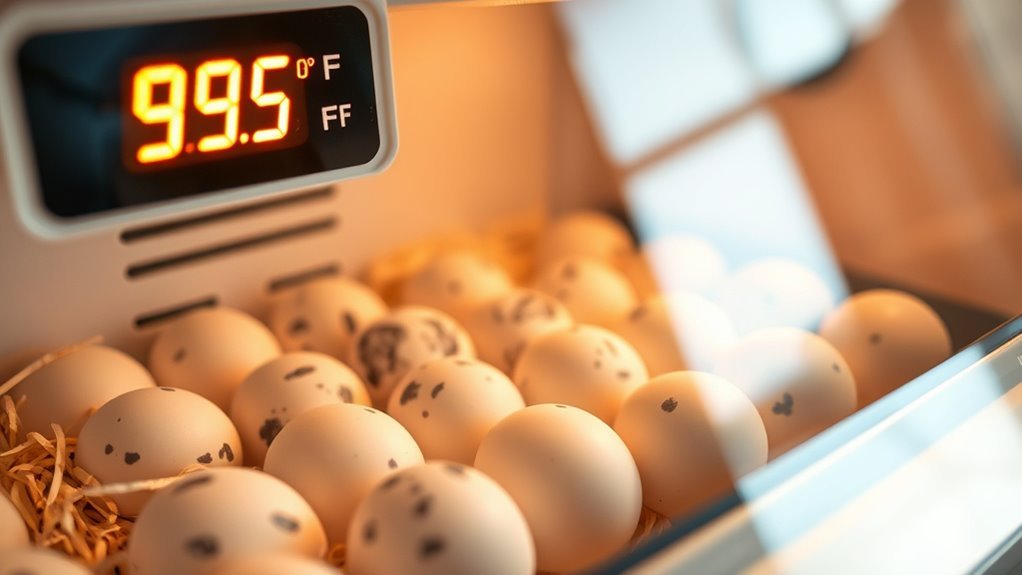
You want to keep your chicken eggs at a steady 99.5°F to guarantee healthy embryo development without risking damage from heat or cold. This ideal temperature for incubating chicken eggs ensures optimal conditions for growth and hatching success.
Forced-air incubators work best at this temperature, while still-air types need slightly higher heat around 101.5°F.
Use reliable thermometers and calibrate them regularly for accurate control. Avoid big temperature swings to prevent weak or failed chicks.
Keep going, and you’ll discover how to fine-tune settings for perfect hatches.
Why Maintaining 99.5°F Incubation Temperature Is Crucial for Healthy Embryos
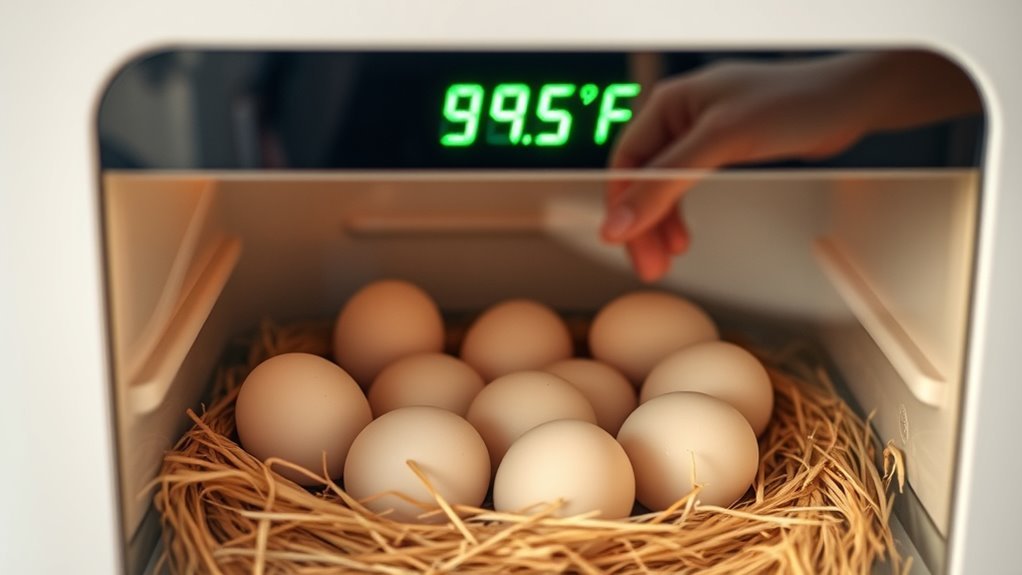
Because maintaining a steady incubation temperature of 99.5°F is essential, you’ll guarantee your chicken embryos develop properly and avoid deformities. During egg incubation, keeping a consistent temperature within 0.5°F mimics a hen’s natural warmth, which supports healthy embryo development.
If the temperature rises above 102°F, embryos risk overheating and death; if it falls below 97°F, development slows or fails. Using a reliable thermometer inside your incubator is key to monitoring this precise temperature. Don’t forget to calibrate it regularly to maintain accuracy.
Along with temperature, controlling humidity also plays a role in hatch rate, but temperature remains the critical factor. By carefully managing your incubator’s temperature, you’ll optimize hatch rates and raise strong, healthy chicks every time.
How Incubator Type Affects Ideal Incubation Temperature Settings
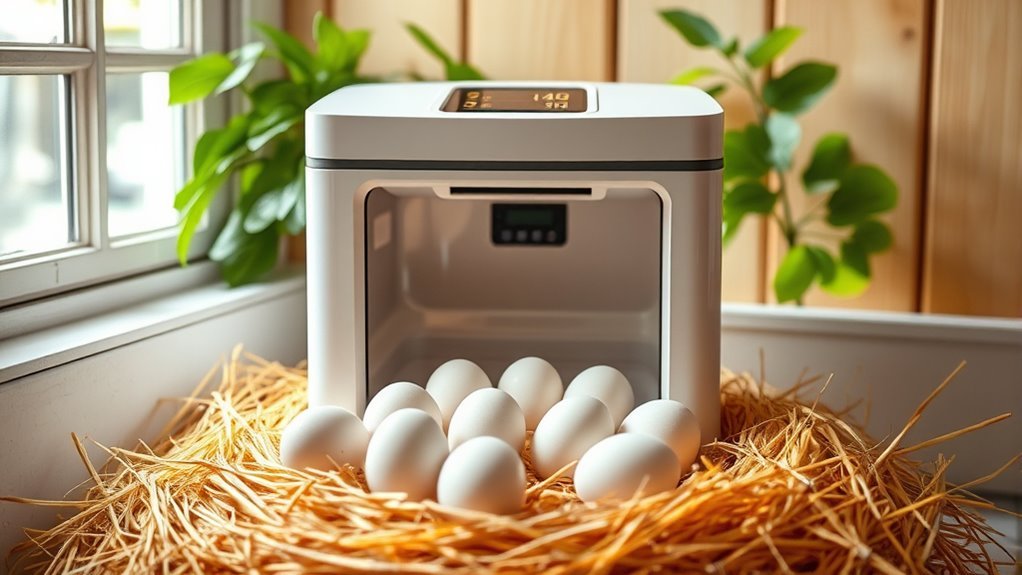
When you choose an incubator type, you’ll need to adjust the temperature settings accordingly to guarantee ideal conditions for your chicken eggs. A forced-air incubator requires about 99.5°F due to its consistent airflow and even temperature distribution. In contrast, a still-air incubator demands a higher setting near 101.5°F at the top of the eggs to compensate for limited airflow.
Adjust incubator temperature based on type: 99.5°F for forced-air, 101.5°F for still-air models.
Here’s what to consider:
- Use precise temperature calibration to maintain temperature accuracy.
- Place the thermometer correctly—at egg level near the top in still-air models.
- Adjust incubation settings based on airflow differences.
- Monitor incubation temperature closely to optimize hatch rate.
Understanding these factors ensures you provide the perfect environment for healthy embryo development.
Effects of High and Low Incubation Temperatures on Embryo Development
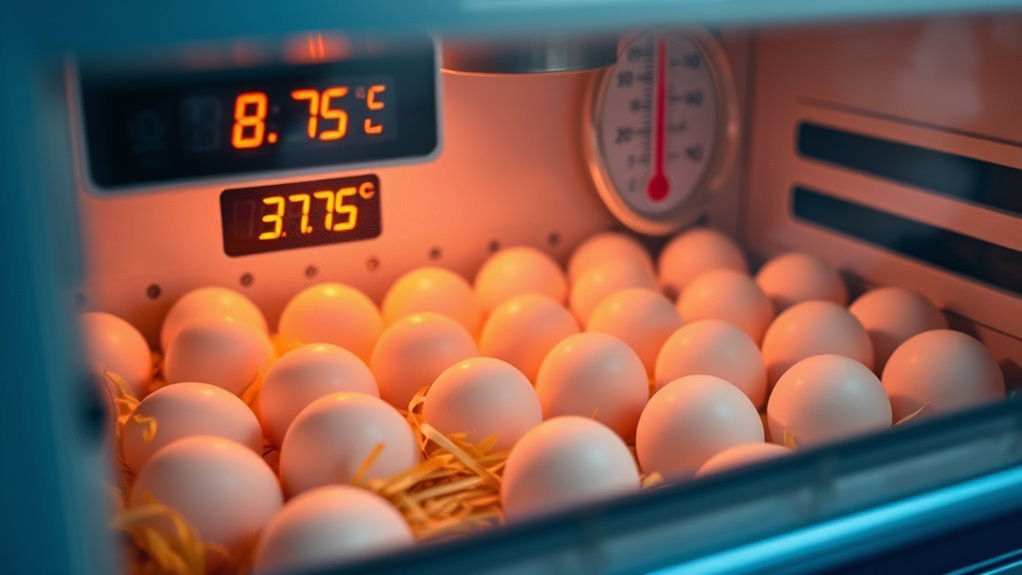
Adjusting your incubator’s temperature based on its type is just one part of successful egg incubation. Maintaining proper temperature control is essential because a high temperature above 102°F can cause rapid embryo mortality, leading to incubation failure. On the other hand, incubation temperatures below 99°F slow embryo development, extending the incubation period or causing hatch failure.
You’ll notice that consistent high temperatures produce weak or malformed chicks, while low temperatures yield non-viable embryos, both reducing chick viability. Additionally, temperature fluctuation exceeding 1°F during incubation markedly lowers hatch rate and increases developmental problems.
To optimize hatch success, you must keep the incubation temperature steady around 99.5°F, ensuring proper embryo development and minimizing risks of embryo mortality, incubation failure, and poor chick viability throughout the incubation period.
How to Accurately Measure and Calibrate Incubation Temperature
To guarantee your incubator maintains the ideal temperature, you’ll need to measure and calibrate it accurately using a reliable digital thermometer or an aquarium thermometer with a probe. Proper thermometer calibration ensures consistent temperature control critical for healthy embryo development.
Follow these steps for accurate readings:
- Use a digital or probe thermometer to check incubation temperature inside the incubator.
- Perform an ice-water test by placing the thermometer in melting ice; it should read 32°F (0°C).
- Adjust calibration based on the difference between your thermometer’s reading and the true ice-water temperature.
- Verify thermometer accuracy regularly, ideally comparing with a lab-grade thermometer for precise monitoring.
Consistent thermometer accuracy guarantees proper temperature control throughout incubation.
When and How to Adjust Incubation Temperature Through Development Stages
Although maintaining a steady temperature is essential during incubation, you’ll need to fine-tune it slightly as the embryo develops to guarantee ideal hatching conditions. During most development stages, keep the incubation temperature steady—around 99.5°F in a forced-air incubator and 101-102°F in a still-air incubator. Use thermometer calibration regularly to verify accuracy.
Avoid large temperature fluctuations, but if you notice early hatch issues during the last few days incubation, increase the temperature by 0.2°F. This small temperature adjustment can support a smoother hatching process. After hatching, reduce the temperature to about 95°F to protect chicks from overheating.
Frequently Asked Questions
What Temperature Do I Set My Incubator for Chicken Eggs?
You should set your forced-air incubator to about 99.5°F (37.5°C). If it’s a still-air model, aim for 101–102°F (38.3–38.9°C).
Always monitor and keep temperature steady for best results.
What Are the Mistakes for Incubation Eggs?
Did you know temperature swings over 1°F can kill embryos?
You’ll make mistakes if you don’t calibrate your thermometer, rely only on the built-in gauge, place it wrongly, or open the incubator too often.
Is 80% Humidity Too High for Hatching?
Yes, 80% humidity is too high for hatching. You should keep humidity around 50-55% during most incubation and boost it to 65-70% only during the hatch phase to ensure healthy chick development.
Is 102 Too Hot for Hatching Eggs?
Yes, 102°F is too hot for hatching eggs. Temperatures above 102°F can damage embryos within hours, drastically lowering hatch rates.
You’ll want to keep it near 99.5°F to give your chicks the best chance.
Conclusion
Maintaining an incubation temperature of 99.5°F is essential because even a 1°F change can drop hatch rates by up to 20%. You’ll want to carefully choose your incubator type and regularly calibrate its thermometer to keep this temperature steady.
Remember, slight adjustments during development stages can make a big difference in healthy embryo growth. By staying precise, you’ll boost your chances of hatching strong, healthy chicks every time.
In conclusion, keeping the ideal temperature for incubating chicken eggs ensures optimal embryo development and higher hatch rates. Consistent temperature control is key to successful incubation and producing healthy chicks.