How to Choose the Right Size Loaf Pan for Sandwich Bread
You choose the right loaf pan size by matching its volume to your flour amount and bread type. Selecting the ideal loaf pan is crucial for achieving the perfect sandwich bread texture and shape.
For about 3 cups of flour, an 8 1/2 x 4 1/2-inch pan works well; around 3 1/2 to 4 cups fits better in a 9 x 5-inch pan.
Fill pans two-thirds full to ensure proper rise and bake time. Knowing how pan size impacts loaf shape and baking helps you get perfect sandwich bread every time.
Keep exploring to find the best fit for your recipe.
Standard Loaf Pan Sizes for Sandwich Bread
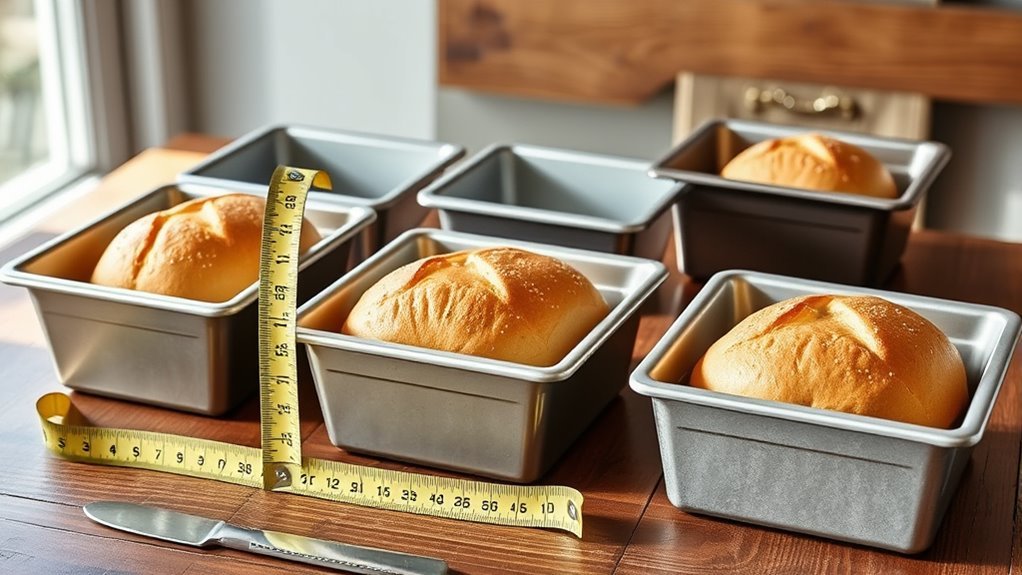
When you bake sandwich bread, choosing the right loaf pan size matters. The most common loaf pan sizes for a standard loaf pan are 9 x 5 inches and 8 1/2 x 4 1/2 inches. The 9 x 5-inch pan holds about 8 cups of dough, perfect for a traditional bread loaf that yields uniform slices.
The smaller 8 1/2 x 4 1/2-inch pan has a 6-cup capacity, ideal if you prefer a thinner or smaller bread loaf. Both pans have sides at least 2 1/2 inches tall, providing enough volume for proper rise. Sticking to these standard loaf pan sizes helps you bake consistent bread loaves, ensuring even baking and the classic loaf shape you want.
How Pan Size Affects Bread Rise and Shape
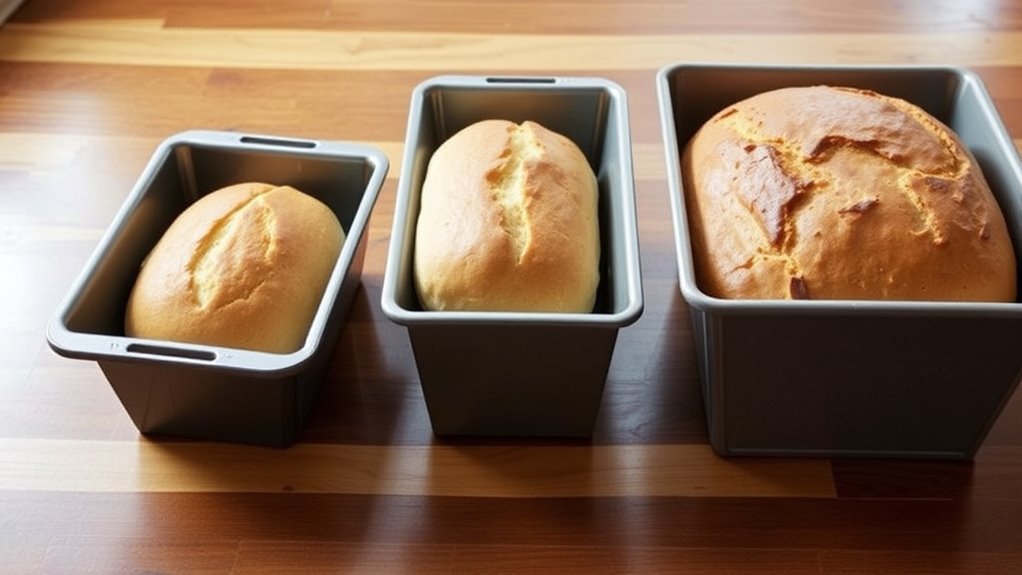
When you use a smaller pan, your bread rises higher and forms a taller loaf, while a larger pan spreads the dough out for a flatter shape.
Keep in mind, even a half-inch difference in pan size can change the loaf’s height by about 15%. Also, the type of flour you use will affect how much your bread rises and shapes up.
Smaller Pans Create Taller Loaves
Although you might be tempted to use a larger pan for convenience, choosing a smaller loaf pan like an 8 1/2 x 4 1/2 inch will make your bread rise higher, giving you a taller, more domed loaf. Smaller pans limit the dough’s horizontal spread, forcing it to rise vertically, which directly affects the height of loaf you get.
When you use the same amount of dough in a smaller pan, it creates a taller loaf with a mushroom-shaped top. This increased vertical rise not only improves the loaf’s height but also results in a more aesthetically pleasing shape.
Larger Pans Yield Flatter Loaves
While smaller pans encourage your dough to rise upward, larger loaf pans like the common 9 x 5 inch size give the dough more room to spread out horizontally. When you use larger pans, the increased surface area lets the dough expand sideways, which limits its vertical rise. This results in flatter loaves with a wider, less domed top.
If you want a taller loaf, the pan size plays a vital role—larger pans naturally produce shorter, broader bread. To avoid overly flat bread, consider using less dough or a smaller pan. Understanding how pan size affects your bread’s rise helps you control the shape and texture, so you can bake sandwich bread that fits your preferences perfectly.
Flour Type Influences Rise
Because different flours develop gluten differently, the type of flour you choose directly affects how your dough rises and fits in your loaf pan. High-gluten flours like bread flour create strong gluten networks, resulting in a vigorous rise that can overflow if your loaf pan size is too small, causing a domed loaf.
In contrast, whole wheat and other whole-grain flours produce denser doughs with less rise, so smaller pans help maintain a neat shape without overfilling. If you use lower-protein flours, opting for a larger loaf pan size lets the dough expand properly, preventing a flat or compressed loaf.
Understanding how flour type influences rise ensures you pick the right loaf pan size, achieving the ideal bread shape every time.
Choosing Loaf Pan Size by Flour Amount and Type
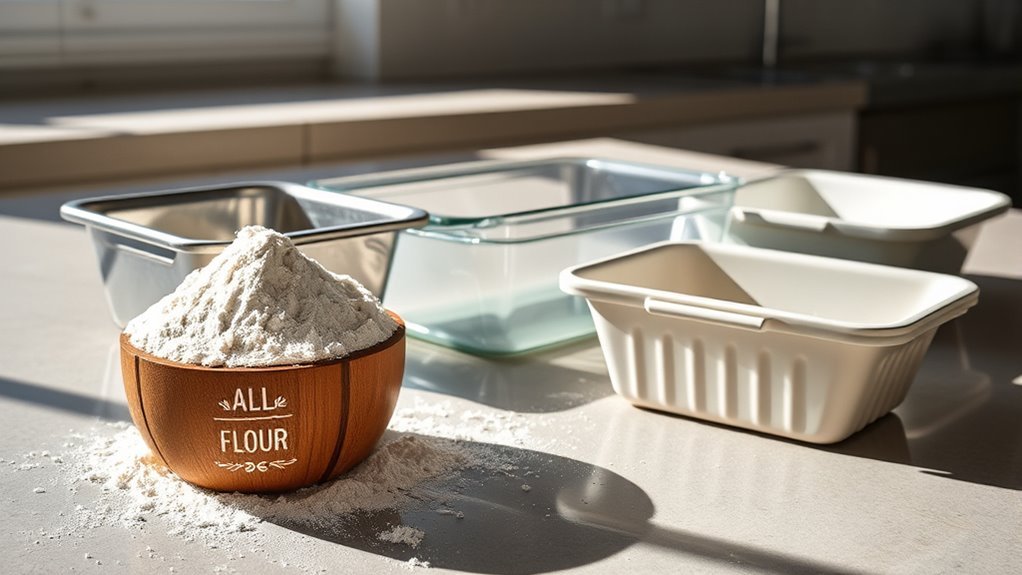
When choosing a loaf pan, consider the amount and type of flour your recipe calls for to guarantee the dough fits properly and bakes evenly. If your recipe uses about 3 cups of flour, an 8 1/2 x 4 1/2-inch pan works well, especially for lighter or white bread doughs.
For around 3 1/2 cups of whole-grain flour, pick a smaller pan to prevent the denser dough from over-expanding and losing shape. When your flour amount reaches 3 3/4 cups or more, a 9 x 5-inch pan is ideal to handle the larger dough volume.
Adjust your pan size based on flour type and amount to ensure your loaf rises well without overflowing or baking unevenly.
Measuring Your Loaf Pan’s Volume Accurately
To measure your loaf pan’s volume accurately, you can fill it with water and then pour the water into a measuring cup to find its capacity. Alternatively, measure the pan’s internal length, width, and height, then multiply these dimensions to calculate its volume in cubic inches.
Converting that number to cups helps you match your pan to recipe requirements with confidence.
Water Displacement Method
If you want to know your loaf pan’s exact volume, try the water displacement method. First, make sure your pan is clean and dry. Then fill it with water to the top edge.
Pour the water into a liquid measuring cup to measure the volume accurately. This method lets you measure the volume precisely, helping you choose the perfect loaf pan size for your recipe. Record the amount in cups or milliliters and compare it to common pan sizes.
| Step | Action | Purpose |
|---|---|---|
| 1 | Clean and dry pan | Avoid inaccurate measurements |
| 2 | Fill with water | Use water displacement method |
| 3 | Pour water out | Measure volume accurately |
| 4 | Record volume | Note exact loaf pan size |
| 5 | Compare size | Match recipe requirements |
Dimension-Based Calculation
Although water displacement offers a direct way to measure your loaf pan’s capacity, calculating volume from its dimensions gives you a quick and reliable estimate. To calculate the size and volume, measure your pan’s internal length, width, and height accurately with a ruler or tape measure. Multiply these three dimensions (length × width × height) to get the volume in cubic inches.
Then, convert that number to cups by dividing by 14.44, since one cup equals 14.44 cubic inches. This method helps you quickly determine if your pan is the right size for your sandwich bread recipe. Just remember to double-check your measurements because even slight variations can impact your baking results.
Calculating volume this way keeps you confident in choosing the perfect loaf pan size.
How to Use Pan Size Charts
When you know your loaf pan’s internal dimensions, you can use pan size charts to quickly figure out its volume and compare it to common sizes. First, measure the internal dimensions—length, width, and height—and calculate the volume by multiplying these three. Then, consult a pan size chart to find the equivalent capacity in cups or milliliters.
If your pan’s dimensions are hard to measure, fill it with water and pour the water into a liquid measuring cup for accuracy. Using these charts helps you match your pan’s volume to recipe recommendations, ensuring your bread rises and bakes properly. This way, you can choose the right pan size and avoid guesswork when adapting or scaling recipes.
Tips for Baking With Different Loaf Pan Sizes
Because loaf pans come in various sizes, adjusting your recipe and baking time is essential to get the best results. When using a smaller size pan, reduce ingredient quantities proportionally and shorten baking time to avoid overbaking.
For larger baking pans, increase the recipe slightly or extend baking time to ensure the bread cooks through. Always match your pan’s internal dimensions or volume with the bread recipe’s specifications—most standard pans hold 6 to 8 cups of dough.
You can measure your pan’s capacity using water displacement to verify it fits the dough volume. These adjustments help maintain the loaf’s shape and texture, ensuring your sandwich bread turns out perfectly no matter which pan size you use.
Don’t Have the Right Pan? Here’s What to Do
If you don’t have the exact pan size your recipe calls for, you can still achieve great results by carefully measuring your available pan’s volume and adjusting the ingredient amounts accordingly. Fill your loaf pan with water, pour it into a measuring cup to find its capacity, then scale your bread recipe to match.
If your pan is smaller, reduce baking time and lower the oven temperature slightly to avoid burning. For larger pans, fill only two-thirds full to allow room for rising and watch the baking time closely.
You can also divide dough into multiple smaller pans or use a different pan shape with similar volume. By matching the size loaf pan’s volume, you ensure your bread bakes evenly and maintains the right shape.
Frequently Asked Questions About Loaf Pan Sizes
Adjusting your loaf pan size can raise plenty of questions about how it affects baking times, loaf shape, and ingredient amounts. You might wonder if a 9 x 5-inch loaf pan is better than an 8 1/2 x 4 1/2-inch one for sandwich bread. The key is matching your pan size to the recipe’s flour amount—around 3 1/2 to 4 cups flour fits well in the larger pan.
Using a smaller or larger pan than recommended can change baking time and loaf rise considerably. Even a half-inch difference in pan size can alter capacity by about 15%, affecting your bread’s shape. To get consistent results, measure your loaf pan’s internal dimensions or volume before baking.
This helps you pick the right pan size for perfect sandwich bread every time.
Frequently Asked Questions
What Size Pan to Use for Sandwich Bread?
You should use a 9 x 5-inch loaf pan for sandwich bread since it holds about 8 cups, ensuring proper rise and shape.
For smaller batches, an 8-1/2 x 4-1/2-inch pan works best to avoid uneven baking.
How to Know What Size Loaf Pan to Use?
You know what size loaf pan to use by measuring its internal dimensions or filling it with water to find capacity.
Match this to your recipe’s flour amount, usually 3-4 cups, ensuring proper loaf shape and rise.
How Big Is a Loaf of Sandwich Bread?
A loaf of sandwich bread is typically about 8 to 9 inches long, 4 to 5 inches wide, and 4 inches tall.
It usually weighs around 1 to 1.5 pounds and yields about 16 slices.
What Size Pan Should I Use for Bread?
Use a 9×5-inch pan for bigger batches or an 8 1/2×4 1/2-inch pan for smaller, taller loaves.
Match your recipe’s flour amount to get the best bread size and shape.
Conclusion
Choosing the right loaf pan size is like finding the perfect stage for your bread to rise and shine. When you match your pan to your recipe’s flour and volume, you’re setting the scene for a golden, fluffy masterpiece.
Remember, the right pan shapes not just your bread, but your baking success.
So, grab that perfect pan, and let your sandwich bread steal the show every time! Choosing the right size loaf pan is key to achieving the best texture and crumb in your sandwich bread.