How Many Bed Bugs Hatch From One Egg
You’ll get exactly one bed bug hatchling from each egg—never more, never less. The tiny, white, oval egg holds a single fertilized embryo that hatches in about 6 to 10 days, depending on temperature and humidity.
Understanding how many bed bugs hatch from one egg is crucial for controlling infestations effectively.
Once hatched, the nymph needs a blood meal quickly to survive and grow through multiple stages before becoming an adult.
Each egg leads to just one bug, which helps explain how infestations can expand so fast.
Knowing this can help you grasp the life cycle of bed bugs and what steps you can take to manage and prevent their spread.
How Many Bed Bugs Hatch From One Egg?

Although it might seem surprising, only one bed bug hatches from each egg. Each egg contains just one developing bug that, after an incubation period of about 6 to 10 days, emerges as a tiny nymph.
Under ideal conditions, around 97% of viable eggs hatch successfully, so you can expect most eggs laid by a female to produce offspring. Speaking of females, a single female bed bug can lay up to 500 eggs in her lifetime, which means a lot of nymphs can hatch over time.
Once hatched, the nymph begins feeding and growing through several stages until it becomes an adult. Understanding that only one bed bug hatches from each egg helps you grasp how infestations can quickly expand through multiple generations.
What Do Bed Bug Eggs Look Like and How to Spot Them

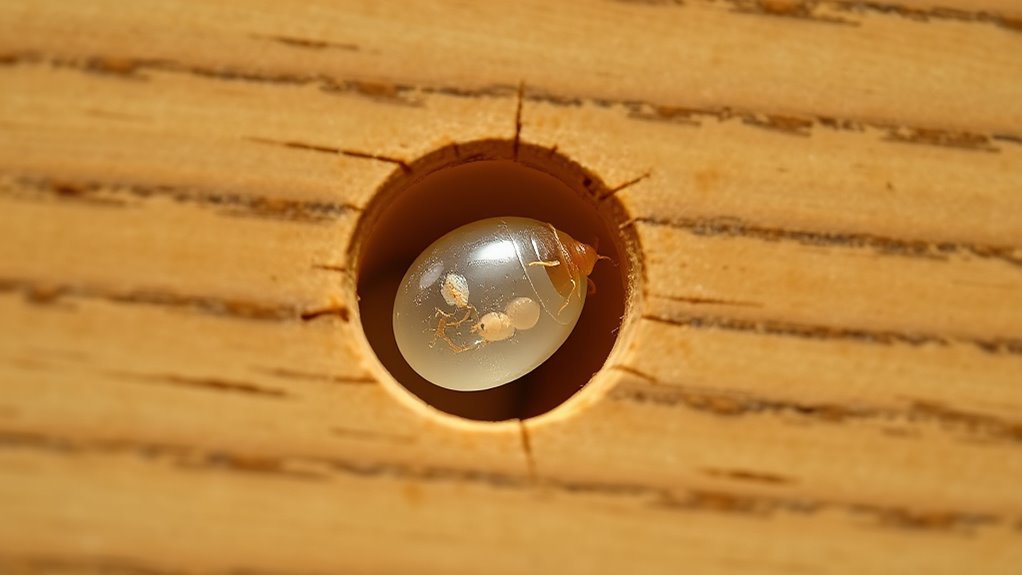
When you want to identify bed bug eggs, you need to look closely for tiny, white, oval-shaped spots about 1 mm long, often found in clusters or hidden crevices like mattress seams. These white eggs have a sticky texture, helping them cling to hidden spots such as cracks and fabric folds. Due to their tiny size and pale color, eggs identification requires careful inspection under good light.
Each bed bug egg holds a single developing nymph that will emerge after the eggs hatch. Spotting these eggs early is vital to control infestations since nymph emergence signals new bed bugs ready to feed and multiply. Keep an eye out in common hiding places to catch bed bug eggs before they hatch and spread further.
How Long Does It Take for a Bed Bug Egg to Hatch?

After spotting bed bug eggs, you might wonder how long it takes for them to hatch and release new pests. Typically, bed bug eggs hatch within 6 to 10 days at normal room temperature. The incubation period varies depending on temperature and humidity; warmer conditions speed up development, shortening the time to about 5 days.
Each egg contains one tiny nymph that emerges after hatching. Understanding these factors helps you estimate when eggs hatch and prepare for treatment.
| Temperature Range | Incubation Time | Resulting Stage |
|---|---|---|
| 70-80°F (21-27°C) | 6-10 days | Nymph hatches |
| Above 80°F (27°C) | ~5 days | Faster hatching |
| Below 70°F (21°C) | >10 days | Slower hatching |
What Happens Right After a Bed Bug Egg Hatches
Right after a bed bug egg hatches, you’ll see a tiny, nearly transparent nymph emerge, which is soft-bodied and fragile. It’s immediately hungry and starts searching for a blood meal to survive and grow.
During this vulnerable stage, the nymph must feed quickly to continue its development.
Emergence Of Nymph
As soon as a bed bug egg hatches, you’ll notice a tiny, translucent nymph emerging, almost like a minuscule speck of sand. This emergence marks the beginning of a new life cycle. The nymph is incredibly small and nearly transparent at hatch, but it’s already hungry.
To grow, it must find a blood meal that fuels its first molt within about a week. Each blood meal increases the nymph’s size and darkness as it advances through successive molts. These molts are essential stages, allowing the nymph to develop into more mature forms.
Understanding this emergence helps you see how a single egg can kick off a series of molts, eventually leading to a fully grown bed bug.
Immediate Blood Feeding
How quickly do bed bug nymphs need to feed once they hatch? The moment bed bug eggs hatch, the larvae—or nymphs—emerge nearly transparent and extremely hungry. These tiny nymphs must find a blood meal within minutes to hours to survive and continue development.
Feeding is critical right after hatching because nymphs require a blood meal before each of their five molts. Without this essential feeding, they cannot grow or mature into adults.
Here’s what happens immediately after bed bug eggs hatch:
- Nymphs emerge from eggs after 6-10 days
- Newly hatched larvae are nearly transparent and vulnerable
- They seek a host quickly to obtain their first blood meal
- Feeding triggers growth and progression through developmental stages
- Lack of feeding results in nymph death and halted development
Vulnerability And Growth
Once bed bug nymphs feed shortly after hatching, their vulnerability remains high but their growth accelerates. When an egg hatches, the tiny, nearly transparent nymphs are extremely vulnerable and can’t survive long without their first blood meal.
This initial feeding is vital because it kickstarts their growth and allows them to begin molting through five developmental stages. Without a blood meal, the nymphs can’t shed their exoskeletons or progress, halting their development.
Although feeding reduces some risk, nymphs remain fragile during these early stages. Every blood meal supports their molting process and increases their size, pushing them closer to adulthood.
How Bed Bug Nymphs Grow and Develop After Egg Hatching
Though bed bug nymphs start out tiny and nearly invisible, you’ll notice them growing quickly after hatching. These nymphs undergo a fascinating development process involving multiple growth stages. Each stage requires a blood meal before molting, allowing the nymphs to increase in size and change color.
Bed bug nymphs grow rapidly through stages, needing blood meals to molt and change color.
Here’s what happens after the egg hatch:
- Nymphs begin as translucent and about the size of a grain of sand.
- They must feed on blood before each of the five molting stages.
- Molting occurs roughly every week under ideal conditions.
- With each molt, nymphs grow larger and shift from transparent to reddish-brown.
- Full development from nymph to adult takes about five weeks.
Understanding this cycle helps you grasp how quickly bed bugs can multiply and infest.
Temperature and Environment Affecting Bed Bug Egg Hatching
Because temperature and humidity directly influence bed bug egg development, understanding these factors can help you anticipate when eggs will hatch. The essential temperature range for egg hatching is between 21°C and 32°C (70°F to 90°F), where incubation speeds up, and eggs typically hatch within 6 to 10 days.
Cooler temperatures slow the development process, potentially delaying hatching beyond 10 days. Humidity also plays a vital role; higher humidity levels promote faster egg incubation, while dry conditions can hinder hatchability. Fluctuating temperatures in the environment cause irregular egg hatching times, making it harder to predict when infestations will worsen.
Why Each Bed Bug Egg Produces Only One Hatchling
You’ll notice that each bed bug egg holds just one embryo, so it can only produce a single nymph. The egg’s structure and size naturally limit development to one hatchling at a time.
Understanding this biological process helps explain why bed bugs don’t hatch in groups from one egg.
Single Egg, Single Nymph
Each bed bug egg contains a single fertilized embryo, which means it hatches into only one nymph. This single egg structure is fundamental to the bed bug life cycle, ensuring that each egg supports just one nymph’s development. Unlike some insects that can produce multiple offspring from one egg, bed bug reproduction is streamlined: one fertilized embryo per egg leads to one hatchling.
When the eggs hatch, the embryo has received enough nutrients to support the nymph development process, but not enough for multiple larvae. Here’s what you should know about this process:
- Each egg houses only one fertilized embryo
- Eggs hatch into a single nymph, never multiples
- Nutrient supply in eggs sustains one developing nymph
- Single egg equals single hatchling in bed bug reproduction
- This pattern is consistent throughout the bed bug life cycle
Biological Development Process
When you look closely at bed bug eggs, you’ll see they contain just one fertilized ovum, which naturally limits development to a single embryo. This is key to understanding why each egg produces only one hatchling. The reproductive process in bed bugs is designed so that every egg develops one embryo, which matures into a nymph after hatching.
The egg’s size and internal structure simply don’t support multiple embryos developing simultaneously. As the embryo grows, it consumes the resources inside the egg to fuel its development until it’s ready to hatch as a single nymph. This biological development process ensures a one-to-one ratio of eggs to hatchlings, making it impossible for one bed bug egg to produce more than a single individual through natural reproduction.
How Fast Egg Laying Causes Bed Bug Infestations to Grow
Because female bed bugs lay up to five eggs daily, their populations can explode in just weeks. You might not realize how quickly a few eggs hatch into a full infestation. Each egg hatches within 6 to 10 days, releasing nymphs that need blood meals to mature.
This rapid reproduction cycle fuels the infestation’s rapid growth.
Consider these key points:
- A single female lays up to 5 eggs per day, totaling around 500 in her lifetime.
- About 97% of eggs hatch under ideal conditions.
- Nymphs grow through stages, each requiring feeding.
- Continuous egg laying results in exponential population increases.
- Within weeks, a small number of bed bugs can multiply into hundreds or thousands.
Understanding this helps you grasp why infestations escalate so fast.
Tips to Prevent Bed Bug Eggs From Hatching in Your Home
Although bed bug eggs are tiny and often hidden, you can take effective steps to stop them from hatching in your home. To prevent hatching, maintain temperatures below 65°F or above 85°F, since bed bug eggs hatch best between 68°F and 85°F.
Regular vacuuming and cleaning of bedding, mattress seams, and furniture crevices remove eggs before they hatch, helping control infestations. Using bed bug-proof mattress and box spring covers traps eggs and prevents them from hatching. Additionally, eliminating clutter and sealing cracks reduces hiding spots for eggs and immature bugs, lowering the risk of infestation growth.
Frequently Asked Questions
Can One Bed Bug Egg Cause an Infestation?
Yes, one bed bug egg can start an infestation. Once it hatches, the nymph grows, reproduces, and lays hundreds of eggs, quickly multiplying the population if you don’t take prompt action to control it.
What Do Bed Bug Eggs Look Like on Clothes?
Bed bug eggs on clothes look like tiny, white or cream-colored grains of salt. You’ll find them sticky, usually hidden in seams, folds, or tags, making them tough to spot without a careful, close-up inspection.
How Many Eggs a Day Do Bed Bugs Lay?
You might be surprised, but bed bugs lay about 1 to 5 eggs daily. If conditions favor them, you could see up to seven eggs per day.
At What Life Stage Do Bed Bugs Lay Eggs?
You’ll find that bed bugs lay eggs only when they reach adulthood. They don’t start laying eggs during their early nymph stages, so you won’t see egg-laying until they’re fully mature and have had a blood meal.
Conclusion
Now that you know each bed bug egg gently welcomes just one tiny guest into the world, you can better appreciate how quickly these little invaders multiply. By understanding their delicate beginnings and growth, you hold the power to interrupt their cozy plans before they start.
Stay vigilant, create an uninviting environment, and don’t let these uninvited visitors settle in. Your home deserves to remain their no-go zone, free from any unwelcome surprises. Understanding how many bed bugs hatch from one egg is key to effective prevention and control.