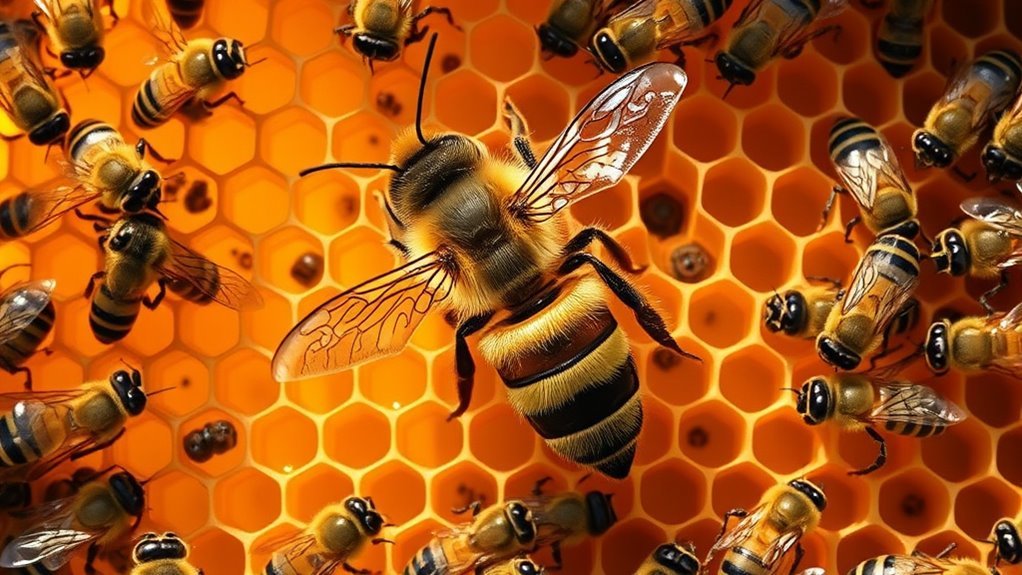
How Many Eggs Does a Queen Bee Lay Each Day?
You can expect a queen bee to lay around 1,700 eggs daily during the hive’s peak season, fueling the colony’s growth and strength. Her egg-laying varies with her health, age, nutrition, and seasonal changes—she peaks in spring and summer but slows down in fall and winter.
If conditions worsen or she ages, egg production drops or stops entirely. Understanding these factors shows why her role is essential for a thriving hive and colony stability.
How Many Eggs Does a Queen Bee Lay Each Day?

How many eggs does a queen bee lay each day? During peak season, a healthy queen can lay between 1,500 to 2,000 eggs daily. On average, you’ll see her egg production hover around 1,700 eggs per day when the hive conditions are just right.
This incredible laying capacity guarantees the colony grows and thrives, especially in spring and early summer months. As the queen ages or if the hive faces limited resources, her egg production naturally declines. You’ll notice that the queen’s ability to keep laying eggs depends heavily on the hive’s space, food availability, and overall colony health.
Biological and Environmental Factors Affecting Queen Bee Egg Laying

Because several biological and environmental factors influence a queen bee’s egg-laying, understanding these can help you support her productivity. The queen’s reproductive capacity depends heavily on her health and hive conditions. Environmental factors like temperature and colony size also affect egg production.
Additionally, colony resources such as ample nectar and pollen are vital for sustaining egg laying. Without enough empty cells in the hive, the queen can’t deposit eggs efficiently.
| Factor | Impact on Egg Laying |
|---|---|
| Queen Health | Directly affects capacity |
| Hive Conditions | Space availability essential |
| Colony Resources | Nutrient supply supports egg production |
| Environmental Factors | Temperature influences rate |
| Colony Size | Affects overall productivity |
How the Queen Bee’s Age Influences Egg Production

You’ll notice that a queen bee’s egg production peaks during her first couple of years, when she lays up to 2,000 eggs daily.
As she gets older, her egg-laying slows down and the eggs may be smaller, which affects the colony’s growth.
Understanding this timeline helps you see why beekeepers replace aging queens to keep the hive strong.
Egg Production Over Time
Although a queen bee can lay up to 2,000 eggs per day during her first year, her egg production usually declines as she ages beyond one or two years. You’ll notice that as the queen’s egg-laying capacity lessens, her daily output often drops below 1,000 eggs. This decline in egg production is a natural part of the queen bee’s aging process.
Factors like her overall health, environmental conditions, and available resources in the colony also influence how many eggs she lays each day. Over time, reduced reproduction signals the colony to contemplate replacing her to maintain hive strength. By understanding egg production over time, you can better appreciate how the queen’s aging affects the colony’s growth and sustainability.
Peak Laying Years
When a queen bee reaches between one and two years old, she hits her peak egg-laying capacity, often producing over 2,000 eggs daily. During these peak years, the queen bee’s reproductive cycle is at its most vigorous, maximizing the egg count per day to sustain colony growth.
Queen age plays an essential role in egg production, as the highest output typically occurs in the first and second years of queen longevity. You’ll notice that some queens maintain near-peak egg-laying capacity for up to three years under ideal conditions.
Understanding this helps you manage hive productivity effectively, knowing that the queen’s egg-laying capacity during her prime years is critical for a thriving colony’s success.
Decline In Older Queens
As queen bees age beyond their prime, their egg-laying capacity drops markedly, often falling below 1,000 eggs per day. You’ll notice queen decline impacting colony productivity as fertility wanes and the brood pattern becomes irregular. Worker bees detect reduced pheromone signals from an aging queen, often triggering supersedure to maintain hive health.
Beekeepers usually perform queen replacement after 1-2 years to sustain high egg production.
Here’s what happens as queen age increases:
- Ovaries deteriorate, reducing fertility and daily egg count.
- Pheromone production weakens, signaling queen’s decline.
- Brood pattern becomes patchy, affecting colony growth.
- Supersedure occurs to restore egg-laying capacity and productivity.
Understanding this helps you manage hives for ideal performance.
How Seasonal Changes Affect Queen Bee Egg Laying
Because seasonal changes directly influence the hive environment, the queen bee adjusts her egg-laying rate to match the colony’s needs. During spring and summer, seasonal variation boosts egg production, with the queen bee laying up to 2,000 eggs daily when hive activity and resource availability peak.
As fall and winter approach, environmental cues like shorter daylight and cooler temperatures prompt her to slow or stop oviposition. This reduction aligns with decreased hive activity and limited resources, conserving energy as brood rearing demands drop. In winter, egg production can fall below 100 eggs per day or halt entirely, depending on hive conditions.
Understanding these seasonal shifts helps you see how the queen bee balances egg laying with the colony’s changing capacity to support new brood.
How Nutrition and Hive Conditions Affect Queen Bee Egg Production
Although seasonal changes set the stage for egg laying, the queen bee’s reproductive success largely depends on nutrition and hive conditions. You’ll notice that her egg-laying capacity thrives when worker bees supply ample royal jelly and pollen, essential for her queen reproductive health. Poor hive conditions, like overcrowding or food shortages, diminish egg production.
To keep her prolific, focus on these:
- Ensure consistent access to high-quality pollen and nectar.
- Maintain ample space to prevent hive overcrowding.
- Provide steady royal jelly for ideal nutrition.
- Monitor and regulate hive temperature to reduce stress.
What Causes a Queen Bee to Stop Laying Eggs?
You might notice the queen bee stops laying eggs when environmental stressors like pesticides impact her health or the hive’s conditions worsen. If her health declines due to age or disease, her egg production can slow or halt entirely.
Additionally, changes in colony dynamics, such as being replaced or reduced pheromones, can cause workers to limit her egg-laying.
Environmental Stress Factors
When environmental stress factors impact a hive, the queen bee often responds by reducing or stopping her egg laying. Various environmental stressors directly affect hive health and the queen bee’s reproductive output. You need to watch for these key stress factors:
- Varroa mites and other parasites weaken the queen, causing decreased egg laying.
- Temperature fluctuations, especially prolonged cold, disrupt the queen’s ability to lay eggs.
- Poor nutrition from insufficient food resources limits the queen’s reproductive capacity.
- Hive management issues like overcrowding or poor ventilation increase stress, leading to halted egg laying.
Queen Health Decline
Environmental stress factors can weaken the queen bee, but her health decline stems from several specific causes that directly affect her ability to lay eggs. When queen pheromone levels drop, worker bees sense reproductive decline, reducing support for egg-laying. Poor nutrition harms queen health and lowers egg production.
Age deteriorates ovary function and reproductive organs, cutting egg-laying capacity. Diseases or parasites like Varroa mites further impair queen vitality. Physical injuries to her reproductive tract or stinger can halt egg production altogether.
| Cause | Effect on Queen Bee |
|---|---|
| Low queen pheromone | Signals reduced egg-laying |
| Poor nutrition | Weakens queen health |
| Aging | Diminishes ovary function |
| Disease/parasites | Impairs reproductive organs |
| Physical injury | Stops or reduces egg production |
Colony Dynamics Impact
Although a queen bee’s egg-laying is essential for colony survival, various colony dynamics can cause her to stop. You should understand that changes in egg-laying capacity often reflect the hive’s overall health and conditions. Here are key factors affecting the queen bee’s egg production:
- Declining pheromone signals due to queen aging prompt worker bees to initiate supersedure.
- Poor hive conditions or insufficient food reduce the queen’s ability to maintain steady egg production.
- Overcrowding and lack of empty cells create space constraints, forcing the queen to pause egg-laying.
- Disease or injury, impacting colony health, can cause the queen bee to cease laying eggs altogether.
Recognizing these dynamics helps you grasp how colony health directly influences the queen’s crucial role.
How Beekeepers Manage and Replace Egg-Laying Queens
To keep your hive thriving, you’ll need to manage and replace the queen bee regularly, often on an annual or semi-annual basis. Beekeepers monitor queen performance closely, watching for declines in eggs laid or pheromone signals.
Regular queen management ensures a thriving hive by monitoring egg production and pheromone activity.
When it’s time for queen replacement, you can rely on queen rearing techniques, where young larvae are grafted into specially prepared queen cells to raise new queens. These queen cells develop into healthy queens ready to take over the colony.
You may introduce a new queen by cage introduction or direct placement, ensuring a smooth shift. Whether the colony naturally supersedes the queen or you intervene, managing queens helps maintain strong egg production and overall hive robustness.
Effective queen management lets you keep your colony productive and healthy.
Why Queen Bee Egg Laying Is Vital for Colony Growth and Health
Because the queen bee lays thousands of eggs daily during peak season, she directly drives the hive’s growth and strength. Her egg laying fuels colony growth by constantly replenishing worker bees, which are essential for foraging, brood care, and hive defense.
You’ll notice that brood production depends heavily on her queen health; any drop in egg laying signals potential problems that can weaken the entire hive. Here’s why her role is critical:
- Sustains colony population by producing larvae that develop into worker bees.
- Maintains hive productivity by ensuring enough workers for food storage and defense.
- Supports colony stability by replacing aging or dead bees.
- Reflects overall queen health, with consistent egg laying indicating a thriving hive.
Frequently Asked Questions
What Is the Lifespan of a Queen Bee?
You can expect a queen bee to live between 2 to 3 years, sometimes up to 5 if conditions are ideal.
With good care, nutrition, and hive health, she’ll stay productive longer and thrive.
What Smell Do Bees Absolutely Hate?
You might be surprised, but bees absolutely hate the smell of citronella. Along with ammonia and cinnamon, these scents repel them fiercely.
Use peppermint or eucalyptus cautiously—they can drive bees away or make them agitated fast.
What Happens if Two Queen Bees Are Born?
If two queen bees are born, you’ll see them fight fiercely until one dies or gets expelled. The first queen to hatch hunts the other, and worker bees might help decide which queen survives.
This intense rivalry ensures that only one queen remains to lead the hive. The struggle can be quite aggressive, reflecting the importance of a single queen for colony stability. Worker bees play a crucial role in supporting the dominant queen and removing the rival.
How Do Bees Decide Who the Queen Is?
You witness a royal contest where the first queen to bloom asserts her reign by outshining rivals.
Bees decide the queen by nurturing potential candidates and letting nature’s duel crown the true leader.
Conclusion
Now that you know a queen bee can lay up to 2,000 eggs a day, it’s easy to see why some believe she never rests. But the truth is, her egg-laying depends heavily on age, season, and hive conditions—you won’t find her working non-stop year-round.
So, while the idea of a tireless queen sounds impressive, it’s actually her environment and health that truly dictate how many eggs she lays each day, keeping the colony thriving.
Understanding how many eggs a queen bee lays each day helps highlight the importance of maintaining healthy hive conditions for optimal reproduction and colony growth.