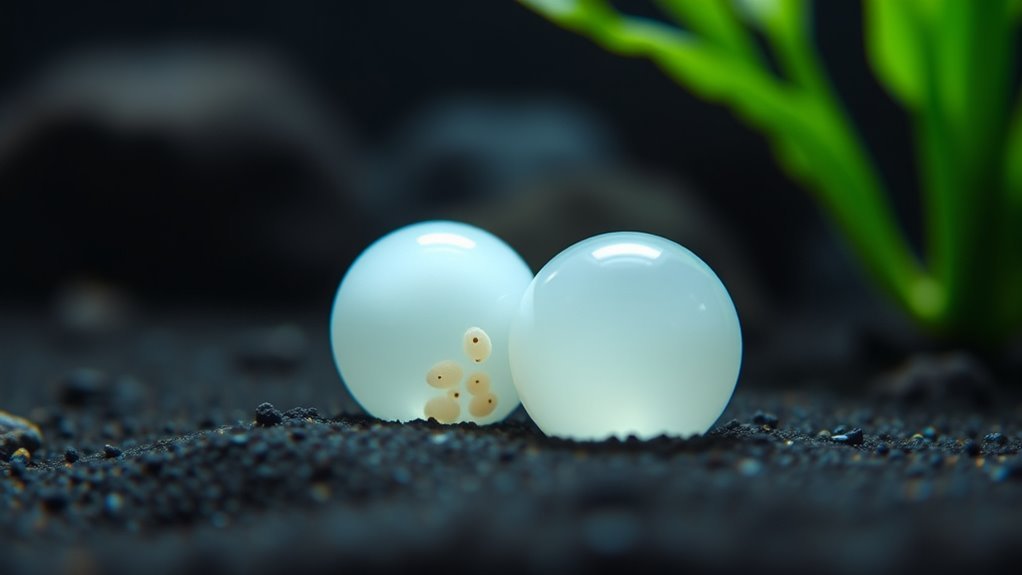
How to Tell if Cory Eggs Are Fertile Step by Step
To tell if your Cory eggs are fertile, start by waiting 2-4 days after they’re laid. Watch their color change from white to light tan or brown—that’s a reliable sign of viability.
Use a flashlight to inspect the eggs gently. Remove any eggs that stay white or develop fuzzy mold to prevent contamination.
Keep the water stable and observe your fish’s spawning behavior to boost success.
Keeping track of these steps helps you spot healthy eggs and improve hatch rates as you learn more about Cory egg fertility. Following this process ensures better outcomes for your breeding efforts.
Spotting Fertile Cory Eggs By Color

How can you quickly tell if your cory eggs are fertile? The key lies in egg coloration. Right after fertilization, a fertilized egg starts changing from white to a light tan or brown shade. This color shift usually happens within 2-4 days.
When you see a uniform, pigmented color across the eggs, it’s a clear sign you’re looking at viable eggs. On the other hand, if the eggs stay white or develop fuzzy patches, they’re likely unfertilized and not viable.
Keeping an eye on consistent color changes helps you spot fertile eggs quickly and confidently. So, by focusing on these color cues, you’ll know which cory eggs have the best chance of hatching successfully.
When And How To Check Cory Eggs After Laying

Although it’s tempting to check the eggs immediately, you should wait 24 to 48 hours after laying to spot early signs of fertilization. When you check cory eggs, use a flashlight to see their color clearly. Fertile eggs typically turn light brown or tan, setting them apart from unfertilized ones.
Handle eggs gently and remove any white or moldy ones to protect the batch.
| Step | What to Do |
|---|---|
| 1. Wait | 24–48 hours after laying eggs |
| 2. Inspect | Use strong light for clarity |
| 3. Identify | Look for light brown/tan eggs |
| 4. Remove | Discard white or moldy eggs |
This method helps you confirm fertile eggs early and maintain a healthy environment.
How To Recognize Infertile Or Moldy Cory Eggs

Wondering how to spot infertile or moldy cory eggs? Recognizing these early helps protect your clutch. Here’s what to look for:
- Egg Coloration: Infertile eggs usually stay white or clear without darkening, unlike fertile ones that turn tan or light brown within days.
- Texture and Growths: Moldy eggs develop fuzzy, cotton-like growths, signaling non-viability.
- Regular Checks: Inspect eggs daily to catch moldy eggs early before they spread.
- Removal: Promptly remove infertile eggs and those with moldy growths to keep the rest healthy.
Why Water Quality Matters For Cory Egg Fertility
You need to keep water parameters stable to give Cory eggs the best chance at fertilization. Maintaining an ideal pH between 6.8 and 7.2 and ensuring ammonia and nitrite stay at zero protects the eggs from damage.
Optimal pH Levels
Since water quality directly impacts corydoras egg fertility, maintaining an ideal pH between 6.0 and 7.0 is essential for successful breeding. Proper pH levels play a critical role in fertilization and embryo development.
Here’s what you need to focus on:
- Keep pH stable within 6.0 to 7.0 to avoid stress that reduces sperm viability.
- Aim for slightly acidic water, around 6.5, to prevent mold growth on eggs.
- Regularly test your aquarium water to catch any pH fluctuations early.
- Adjust pH gently when needed to maintain an environment ideal for embryo development.
Nitrite And Ammonia Impact
Although water pH plays a pivotal role in corydoras breeding, keeping nitrite and ammonia levels at zero is equally important to guarantee egg fertility. Even slight increases in ammonia or nitrite can harm egg viability by damaging the eggs and reducing fertilization success. High levels also stress adult corydoras, impairing their ability to reproduce effectively.
To protect your cory eggs, test your water regularly and perform partial water changes to keep ammonia and nitrite at 0 ppm. Proper filtration helps prevent toxic buildup that compromises egg development. Maintaining these parameters ensures a safe environment where eggs can develop healthily and increases your chances of successful breeding.
Ignoring nitrite and ammonia risks fungal growth and reduced egg viability, so stay vigilant for excellent results.
Maintaining Stable Parameters
When you maintain stable water parameters, you create the ideal environment for cory eggs to develop and hatch successfully. Consistent conditions directly support fertile eggs and promote overall Corydoras health. To keep your tank suitable, focus on these key points:
- Keep the pH between 6.8 and 7.0 to encourage healthy egg development and fertilization.
- Ensure ammonia and nitrite levels remain at zero to prevent toxicity that harms eggs.
- Maintain nitrate levels below 20 ppm to reduce mold growth and support embryo growth.
- Monitor water hardness (GH 4-8°) to sustain breeding Corydoras’ health, enhancing egg viability.
Regular water changes and close monitoring help you maintain these parameters, reducing stress and increasing your chances of seeing fertile eggs hatch successfully.
How Cory Fish Behavior Affects Cory Egg Fertility
You’ll notice males perform a T-pose to signal they’re ready to spawn, which boosts the chances of fertilization. Keep in mind that only mature males can effectively fertilize eggs, so age matters.
Also, a female’s condition and behavior directly influence how successfully eggs get fertilized.
T-Pose Spawning Signal
Because the T-pose signals a male corydoras’ readiness to spawn, watching for this behavior can help you time egg collection for the best chance at fertilization. When you spot a male in T-pose, it means he’s actively engaged in spawning behavior. Here’s what to keep in mind:
- The male spreads his fins and arches his body, showing he’s ready to fertilize eggs.
- Males often compete in T-pose displays, increasing fertilization odds.
- Multiple T-poses over days suggest ongoing spawning activity.
- While T-pose hints at hormonal readiness, it doesn’t guarantee egg fertility.
Male Maturity Impact
Although male corydoras may display spawning behaviors like the T-pose or chasing, these actions alone don’t guarantee successful fertilization. You need to take into account male maturity because only males around 6 to 8 months old have fully developed reproductive organs essential for fertilization. Males that lack proper reproductive development might still perform these behaviors, but their sperm may be insufficient or non-viable, resulting in unfertilized eggs.
To improve your chances of fertile eggs, ensure your males are mature and healthy. Observing active spawning behaviors is a good sign, but without proper male maturity, fertilization won’t reliably occur. So, focus on the age and reproductive readiness of your males to better predict if the eggs you see will develop successfully.
Female Condition Influence
When female corydoras stay healthy and well-nourished, they boost their chances of producing fertile eggs. Your female’s condition directly affects her reproductive success and egg fertility. Here’s what to watch for:
- Make certain she receives a high-protein diet to support her reproductive system fully.
- Maintain excellent water quality to reduce stress that can impair egg fertility.
- Observe for active spawning behavior, signaling readiness and good female condition.
- Avoid breeding immature females, as their eggs often remain infertile.
How To Handle And Move Cory Eggs Safely
To handle and move Cory eggs safely, you’ll want to use a soft, sterile tool like a plastic spoon or gentle tweezers to lift them carefully without causing damage. When transferring the first batch of eggs, place them into a separate container with water matching the main tank’s parameters to help reduce stress.
Make sure the container has proper aeration to keep oxygen levels stable as the eggs become more fragile. Avoid touching the eggs directly with your fingers, as this can harm the developing embryos.
If you notice any moldy or non-viable eggs, remove them promptly to prevent contamination. By following these steps, you’ll ensure your Cory eggs stay healthy and have the best chance of hatching successfully.
Setting Up A Breeding Box For Healthy Eggs
After carefully moving the Cory eggs, setting up a breeding box provides a controlled environment that supports their development. This step is vital to successful egg incubation and healthy growth.
- Use a breeding box with an air stone to guarantee proper oxygenation for the eggs.
- Place the breeding box in a quiet, low-traffic area to minimize stress and disturbance.
- Maintain stable water parameters—pH between 6.5 and 7.2, temperature 75-78°F—to foster ideal egg development.
- Transfer freshly laid eggs promptly, ideally within an hour, to reduce damage and predation risks.
Following these steps helps create the perfect conditions for your Cory eggs to thrive during incubation.
How To Monitor Cory Egg Development Over Time
Although monitoring Cory egg development requires patience, it’s essential for ensuring successful hatching. During incubation, regularly observe the eggs for color changes—fertile eggs usually turn tan or brown within 2-4 days after laying. Use a magnifying glass to closely inspect the eggs’ pigmentation and uniformity.
Keep track of any eggs that remain white or develop fuzzy white patches, as these are signs of non-viable or moldy eggs. Documenting these observations helps you understand the egg development timeline and spot any abnormalities early. Consistent monitoring allows you to distinguish fertile eggs from infertile ones, improving your chances of raising healthy fry.
Paying attention throughout incubation supports a successful breeding process and healthy Cory catfish offspring.
Fixing Common Issues With Cory Egg Fertility
Monitoring egg development gives you valuable insight, but addressing common issues that affect Cory egg fertility can make a big difference in your breeding success. To improve the chances of fertile eggs and maintain egg viability, focus on these key steps:
- Maintain ideal water parameters—keep pH around 6.8-7.0 and nitrate levels low to support healthy fertilization.
- Use mature, healthy males and females to increase fertilization success rates.
- Collect eggs within an hour of laying to minimize damage and unfertilized eggs.
- Remove non-viable eggs—those that are white, fuzzy, or moldy—to prevent fungal spread and protect healthy eggs.
Frequently Asked Questions
How to Tell if Cory Catfish Eggs Are Fertilized?
You can tell Cory catfish eggs are fertilized when they change from clear to tan or light brown within a few days.
If they stay white and fuzzy, they’re likely unfertilized and need removal.
How to Check Eggs to See if They’re Fertile?
You check if eggs are fertile by observing their color change from white to light brown or tan within days. Fertile eggs look translucent or pigmented, while infertile ones stay white or develop mold, which you should remove.
What Are the Signs of a Fertile Egg?
You might think all eggs look the same, but fertile Cory eggs change from white to tan, develop a smooth, glossy surface, and show a tiny embryo inside.
They rarely get moldy, signaling healthy development you can trust.
How Long Does It Take for Cory Catfish Eggs to Hatch?
Cory catfish eggs usually hatch in 3 to 5 days, but warmer water around 78-80°F can speed hatching to about 3 days.
If eggs don’t hatch after 7 days, they’re likely infertile or damaged.
Conclusion
Now that you know how to spot fertile Cory eggs and care for them properly, are you ready to see your little Cory fry thrive? Paying close attention to egg color, water quality, and fish behavior can make all the difference in their development.
Handling eggs gently and monitoring their progress guarantees a higher success rate. These steps help ensure your Cory eggs remain healthy and fertile throughout the incubation period.
With these tips for identifying fertile Cory eggs and maintaining optimal conditions, you’re well on your way to successful Cory breeding. Why not give it a try and watch your aquarium grow with thriving Cory fry?