What Do Mosquito Eggs Look Like in Water?
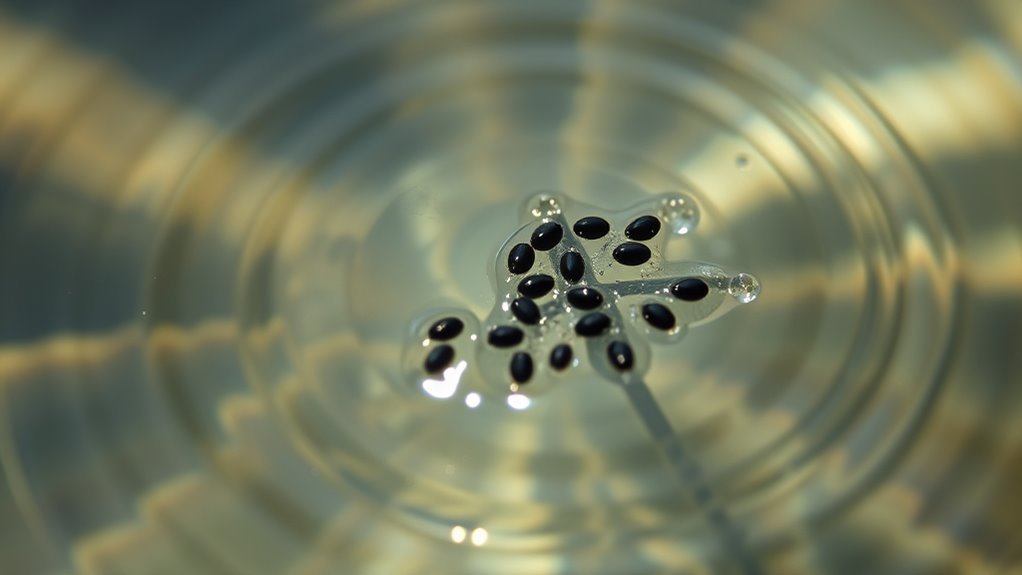
You’ll find mosquito eggs as tiny, dark, shiny clusters floating on the water’s surface, often forming small rafts that look like floating mats. These mosquito eggs in water are about 0.5 mm long each and are closely stuck together by a sticky substance, helping them stay buoyant.
These eggs usually appear in still, standing water like bird baths or puddles. If you pay attention to their size and clustering, you’ll spot them easily.
There’s more to know about how they hatch and how to prevent them.
What Do Mosquito Eggs Look Like in Water?

When you spot small, shiny, dark clusters floating on water, you’re likely looking at mosquito eggs. These eggs are tiny, oval-shaped, and about 0.5 millimeters long, so you might need a close look to see them clearly. Mosquito eggs typically appear in groups called rafts, sometimes holding around 250 eggs, though some species lay them individually.
Their smooth, dark surface stands out against the water, and they usually float on or just above the water’s surface. Depending on the mosquito species, these eggs can hatch within one to five days, making them a critical stage in the mosquito life cycle. Recognizing mosquito eggs on water helps you understand where mosquitoes may soon emerge.
How Do Mosquito Eggs Float and Cluster on Water?

You’ll notice mosquito eggs often form rafts, clustering tightly to stay afloat on the water’s surface.
Surface tension plays a key role, helping these lightweight egg groups resist sinking.
Let’s explore how these patterns keep the eggs moist and ready for hatching.
Egg Raft Formation
Although mosquito eggs can be laid individually, many species, like Aedes mosquitoes, cluster them into egg rafts that float on the water’s surface. These rafts consist of about 250 eggs glued together by a sticky substance secreted by the female mosquito. You’ll notice the entire egg raft uniformly floats, keeping all eggs attached and stable on the water surface.
This formation offers protection from drowning and environmental hazards. Here’s how egg raft formation works:
- Female mosquitoes secrete a sticky substance to bond eggs.
- Eggs cluster tightly, forming a dense raft.
- The raft floats cohesively on the water surface.
- The arrangement ensures eggs remain attached and protected.
This clever adaptation helps eggs survive until they hatch.
Surface Tension Role
Because mosquito eggs rely on water surfaces for development, surface tension plays an essential role in keeping them afloat and clustered. You’ll notice that mosquito eggs form rafts, which surface tension holds together by creating a thin, cohesive film on the water. This film supports the eggs, preventing them from sinking.
The eggs’ water-repellent outer shell adds buoyancy, allowing them to interact effectively with the water surface. Thanks to surface tension, mosquito eggs stay on top of the water, which is crucial for their survival and successful hatching. Without this natural force, the eggs would lose their position and risk submersion, reducing their chances of developing properly.
Clustering Behavior Patterns
When mosquito eggs float on water, they often cluster together in groups called rafts, which can contain around 250 eggs. This clustering behavior helps the eggs stay buoyant and protected. You’ll notice the eggs in a raft are connected by a thin, transparent membrane that keeps them tightly packed.
Not all species form large rafts; some lay eggs individually or in smaller clusters. Here’s what to know about their clustering behavior:
- Eggs in a raft are linked by a delicate membrane, maintaining their cluster.
- Rafts float due to the eggs’ light weight and water’s surface tension.
- Clustering varies by species—some lay one large raft, others smaller groups.
- Rafts appear as small, dark patches on the water surface, making them easier to spot.
How Long Do Mosquito Eggs Take to Hatch?

You’ll find that mosquito eggs typically hatch within 1 to 5 days, but how fast depends a lot on factors like temperature and species.
Warmer conditions speed up the process, while cooler temps slow it down. Understanding these variations helps you predict when larvae will emerge from the water.
Egg Hatching Timeline
If you want to know how long mosquito eggs take to hatch, they usually do so within 1 to 5 days after being laid on water or moist soil. The egg hatching timeline varies based on several factors:
- Temperature: Warmer conditions speed up mosquito eggs’ development.
- Water Quality: Clean, fresh water promotes faster hatching.
- Egg Arrangement: Eggs laid in rafts hatch quicker than solitary eggs.
- Cooler Conditions: Lower temperatures slow down the hatching, extending it toward 5 days.
Understanding this timeline helps you anticipate when larvae might appear. Keep in mind that mosquito eggs are adapted to hatch quickly in favorable conditions, ensuring their survival and continuation of the species.
Environmental Factors Impact
Because environmental factors directly influence mosquito egg development, understanding them helps you predict how quickly eggs will hatch. Typically, mosquito eggs hatch within 1 to 5 days, but this timeline shifts based on conditions. Warmer temperatures speed up egg development, causing eggs to hatch faster, while cooler temperatures slow the process.
If eggs are laid in water with stable, warm conditions and sufficient organic matter, you’ll notice quicker hatching compared to fluctuating or nutrient-poor environments. Additionally, some mosquito eggs can enter a dormant state, resisting drying and delaying hatching until favorable environmental factors return.
Species Variation Effects
How quickly do mosquito eggs hatch across different species? Species variation markedly affects egg hatching times. You’ll notice that:
- Most mosquito eggs hatch within 1 to 5 days.
- Aedes species can hatch as fast as 24-48 hours under ideal conditions.
- Cooler water temperatures slow down egg hatching, often extending incubation to around 5 days.
- Environmental factors like water quality also impact the duration from egg to larva.
Understanding species variation helps you predict when mosquito larvae might appear after eggs are laid. Warmer water generally speeds up the process, but every species responds differently.
Where Do Mosquitoes Prefer to Lay Their Eggs?
When you look for places where mosquitoes lay their eggs, you’ll find they prefer stagnant or still water like ponds, marshes, and puddles. These standing water spots serve as prime breeding sites, providing the calm environment mosquito larvae need to develop.
Besides natural bodies, mosquitoes also target man-made containers—buckets, flowerpot saucers, birdbaths, and old tires—that collect rainwater. Some species even lay eggs on moist soil or mud that floods temporarily, ensuring eggs hatch once water returns.
Mosquitoes favor breeding sites rich in organic material, algae, and bacteria, which support larval growth. By understanding these preferred egg-laying habitats, you can better identify and manage potential mosquito breeding grounds around you.
How to Spot Mosquito Eggs in Standing Water
You can spot mosquito eggs as tiny, dark, oval shapes floating on the surface or attached to objects in still water.
Look closely in containers, puddles, or marshy spots where water doesn’t move. Sometimes, eggs group together in rafts that resemble small floating mats.
Egg Appearance Characteristics
Although mosquito eggs are tiny—about 0.5 millimeters long—they’re visible if you know what to look for. Their egg appearance on water surfaces often makes them stand out as small specks or clusters. Here’s how to identify them:
- Shape: Eggs are elongated and oval, sometimes laid individually or in rafts.
- Clusters: Rafts hold around 250 eggs, appearing as floating mats on still water.
- Color and Texture: They can be semi-transparent or opaque, often shiny or glossy.
- Visibility: Eggs contrast against water, showing as dark or light specks depending on species and water clarity.
Common Egg Locations
Recognizing how mosquito eggs appear on water surfaces helps you know exactly where to look for them. Mosquitoes lay eggs in clusters called rafts that float on standing water or moist soil. You’ll find them in common spots where water collects and stays still, like clogged gutters or bird baths.
Checking these areas regularly helps you spot and eliminate potential breeding grounds quickly.
| Location | Water Type | Egg Appearance |
|---|---|---|
| Clogged gutters | Stagnant water | Clusters on surface |
| Bird baths | Standing water | Tiny oval dots |
| Flowerpot saucers | Moist soil/water | Filmy layers |
| Rain barrels | Stagnant water | Raft clusters |
Focus on these spots to prevent mosquitoes from multiplying.
What Are Common Mistakes in Identifying Mosquito Eggs?
Since mosquito eggs often resemble plant debris, foam, or floating algae, many people mistakenly overlook them or confuse them with other small aquatic life. Misidentification of mosquito eggs is common, especially when you rely on incomplete observation.
To avoid errors, watch out for these frequent mistakes:
- Confusing mosquito eggs with tiny aquatic invertebrates or other insect eggs on water surfaces.
- Assuming all mosquito eggs look identical—variations among species can mislead you.
- Judging eggs solely by size or floating position, which often leads to overlooking eggs smaller than 1 mm.
- Inspecting eggs in murky or debris-filled water, where distinguishing features become obscured.
How Do Environmental Factors Affect Mosquito Egg Development?
Mistaking mosquito eggs for other debris can make it harder to understand how environmental factors influence their development. Temperature plays a critical role; eggs incubate best between 25°C and 30°C, while cooler or hotter conditions slow hatching or reduce viability. You’ll often find mosquito eggs in stagnant water, where stillness and organic material create perfect breeding grounds.
Excessive sunlight can raise water temperature, speeding up hatching but risking egg drying if they’re too exposed. Pollution and chemicals in the water can kill eggs or disrupt larval growth, so clean water isn’t always ideal. Fluctuating water levels, like flooding or drying, can destroy eggs or delay hatching, impacting mosquito populations.
Understanding these factors helps you grasp how mosquitoes thrive in specific environments.
How to Prevent Mosquito Eggs From Hatching in Your Water
To stop mosquito eggs from hatching in your water, you need to eliminate or manage standing water where mosquitoes lay their eggs. Here’s how you can prevent mosquito eggs from developing:
- Regularly drain or replace water in containers like flowerpots, birdbaths, and pet dishes to remove breeding sites.
- Cover water storage containers with tight lids or screens to block female mosquitoes from laying eggs.
- Clear clogged gutters and remove debris that traps standing water around your property.
- Introduce natural predators such as fish or dragonfly nymphs in ponds to reduce larvae and interrupt egg hatching.
Why Can You See Mosquito Eggs Without a Microscope?
Why can you easily spot mosquito eggs without a microscope? Mosquito eggs are about 0.5 millimeters long, making them large enough to see without a microscope. They’re usually laid in clusters called rafts on water surfaces, which makes them stand out.
Their dark brown color and distinct shape help you identify them easily among other debris.
| Feature | Reason You Can See Mosquito Eggs |
|---|---|
| Size | About 0.5 mm, visible to the naked eye |
| Clustering | Laid in rafts, increasing visibility |
| Color & Texture | Dark/brown with distinct texture, noticeable |
Because of these traits, you don’t need specialized equipment to see mosquito eggs clearly on water.
Simple Steps to Keep Mosquito Eggs Out of Your Yard
Now that you can spot mosquito eggs without a microscope, you can take simple steps to keep them out of your yard. Mosquitoes prefer laying eggs on standing water, so managing these areas is key. Here are four effective steps you can take:
- Regularly empty or drain containers that collect standing water, like buckets and plant saucers.
- Clean gutters and remove debris to prevent water buildup.
- Fill or level low spots in your yard where water pools after rain.
- Change water in birdbaths and pet bowls every few days to disrupt mosquito egg-laying.
Frequently Asked Questions
How to Know if Water Has Mosquito Eggs?
You’ll know water has mosquito eggs if you spot tiny, dark, shiny specks or clusters floating on the surface. They often form thin rafts or cling just above the water, signaling eggs ready to hatch.
What Does It Look Like When Mosquitoes Lay Eggs in Water?
You’ll spot tiny, shiny black specks clustered like a miniature raft floating on still water. Mosquitoes lay their eggs in groups, creating delicate, oval-shaped patterns that shimmer subtly before they hatch within days.
Can You See Mosquito Larvae in Water?
Yes, you can see mosquito larvae in water. They look like tiny, wriggling worms about 1/4 inch long, usually near the surface.
They move actively with segmented bodies and breathe through tubes that extend above the water.
How to Identify Mosquito Eggs?
You spot tiny, dark specks floating, you notice smooth, elongated shapes clustered together, you observe glossy egg rafts—these signs help you identify mosquito eggs easily.
Look closely, and you’ll catch them on water surfaces.
Conclusion
Think of mosquito eggs like tiny rafts floating quietly on your water’s surface, waiting to spring into action. Just like a single spark can ignite a wildfire, one cluster of these eggs can quickly turn your yard into a buzzing nuisance.
By spotting and disrupting them early, you’re not just preventing mosquitoes—you’re putting out that spark before it starts. Stay vigilant, and you’ll keep your outdoor space calm and bite-free. Remember, recognizing what mosquito eggs look like in water is the first step to effective mosquito control.