How Do You Incubate Chicken Eggs at the Ideal Temperature
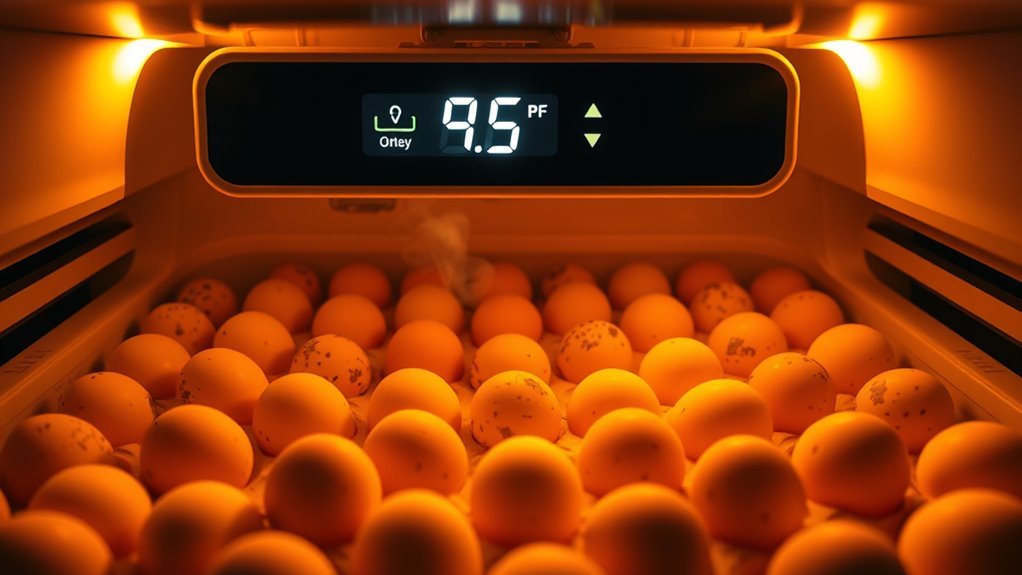
To incubate chicken eggs at the ideal temperature, keep your incubator steadily at 99.5°F (37.5°C) with minimal fluctuations. Maintaining this precise temperature is crucial for successful hatching. Use a reliable, calibrated thermometer placed near the eggs to monitor the heat closely.
Make sure to avoid drafts or direct sunlight near your incubator. Consistently check and adjust the thermostat to maintain this temperature for healthy embryo development.
Along with temperature, factors like humidity and egg turning also play a crucial role in hatching success.
You can explore these additional factors further to achieve the best results and ensure healthy chick development. Proper incubation practices lead to higher hatch rates and stronger chicks.
How To Set And Maintain Ideal Incubator Temperature

Although maintaining the ideal incubator temperature can seem challenging, you can guarantee excellent embryo development by keeping it steady at around 99.5°F (37.5°C). To achieve consistent temperature control, use a reliable thermometer or digital probe placed directly on the eggs, not just inside the incubator.
Regular calibration of your thermometer is essential—test it in melting ice to ensure it reads 32°F (0°C) accurately. Avoid fluctuations greater than 0.5°F (0.3°C) throughout incubation, as even slight temperature swings can harm embryo development.
Monitor the temperature range carefully, and make thermostat adjustments as needed to compensate for environmental changes. Keeping the incubator temperature stable ensures the best conditions for healthy chick hatching.
How To Manage Humidity Levels For Better Hatch Rates

Since humidity plays a crucial role in the development of your embryos, you’ll want to maintain it around 45% during the first 18 days and increase it to about 60% in the final three days. Use a hygrometer inside your incubator to monitor humidity levels accurately, calibrating it with the salt test for precision.
Adjust moisture by adding or removing water from the water trays or using damp towels to raise humidity when needed. Regularly candle your eggs to check the air cell size; proper moisture loss will cause the air cell to grow steadily.
Avoid high humidity early on to prevent drowning or internal pips, ensuring proper moisture balance that improves your hatch rate and promotes healthy chicks.
How To Choose And Calibrate Thermometers Accurately

Maintaining the right temperature is just as important as managing humidity when incubating chicken eggs. To achieve precise temperature control, start by choosing a reliable digital thermometer with a probe or an aquarium thermometer for accurate temperature readings inside your incubator.
Before each incubation cycle, calibrate your thermometer by placing it in crushed ice mixed with water to verify accuracy; it should read 32°F (0°C), the standard temperature. If it deviates, adjust the reading accordingly to ensure accurate measurements.
In still air incubators, measure temperature at the top of the eggs, while in forced air units, any spot inside works. Remember to perform regular thermometer calibration every few incubation cycles to maintain consistent and precise temperature control throughout the process.
Managing Temperature Fluctuations During Incubation
To keep your embryos healthy, you need to keep the incubator temperature steady at around 99.5°F (37.5°C). Managing temperature fluctuations is vital for proper embryo development. Here’s how you can maintain an ideal temperature range:
Maintain a steady incubator temperature around 99.5°F for healthy embryo development.
- Use a reliable thermometer with proper calibration to monitor temperature accurately inside the incubator.
- Place the incubator in a stable environment, avoiding drafts, direct sunlight, or heat sources that cause temperature fluctuations.
- Check temperature at multiple points near the eggs to ensure even heat distribution throughout the incubator.
- Adjust the thermostat promptly if readings stray from the perfect incubator temperature to prevent harm to the embryos.
Combining Temperature, Egg Turning, And Ventilation In Incubation
Although temperature control is essential, you also need to turn your eggs regularly and guarantee proper ventilation to create the best environment for embryo development. Maintain a consistent temperature of about 99.5°F in your incubator, using a calibrated thermometer placed on the eggs.
Turn them at least three times daily—five times is ideal—to prevent the embryo from sticking and to ensure even heat distribution. An automatic turner can simplify this process, but if you turn manually, be gentle.
Proper ventilation is equally important, allowing oxygen exchange and removing excess carbon dioxide without causing drafts. Adjust your incubator’s temperature and ventilation based on humidity and the embryo’s development stage, especially during lockdown.
Balancing consistent heat, egg turning, and ventilation maximizes hatch success and healthy chick growth.
Frequently Asked Questions
What Is the Best Temperature for Incubating Chicken Eggs?
You should keep chicken eggs at about 99.5°F for the best results. Make sure your incubator stays consistent, and calibrate your thermometer regularly to avoid temperature swings that can harm embryo development.
Maintaining a stable temperature is crucial for healthy chick growth. Even small fluctuations can reduce hatch rates or cause developmental issues. Regular monitoring helps ensure optimal conditions throughout the incubation period.
What Are the Mistakes for Incubation Eggs?
You’ll spoil incubation by setting wrong temperatures, opening the incubator too much, not calibrating thermometers, overcrowding eggs, or letting temperature fluctuate.
Avoid these mistakes to ensure healthy embryos and better hatch rates.
How Do You Incubate Eggs for Beginners?
You start by setting your incubator to 99.5°F, calibrate your thermometer, place eggs carefully inside, keep humidity steady, turn eggs regularly, and check temperature twice daily to guarantee a stable environment for hatching success.
Where Is the Best Place to Put an Incubator?
You should put your incubator on a flat surface in a draft-free, stable spot away from direct sunlight and temperature fluctuations.
Choose a room with steady ambient temperature (65-75°F) and good ventilation for best results.
Conclusion
As you carefully set your incubator’s temperature and adjust humidity, you’ll notice how perfectly the warmth and moisture seem to dance together, just like the gentle turning of eggs and steady airflow.
It’s no coincidence that these elements work in harmony—it’s the secret to healthy chicks hatching right on time. When you master these details, you’re not just incubating eggs; you’re creating a little miracle, one perfect day at a time.
Maintaining the ideal temperature is crucial for successful incubation. Consistent warmth ensures proper embryo development, while balanced humidity prevents drying or excessive moisture.
By focusing on these factors—ideal temperature, humidity control, and gentle egg turning—you set the stage for optimal chick development and successful hatching.