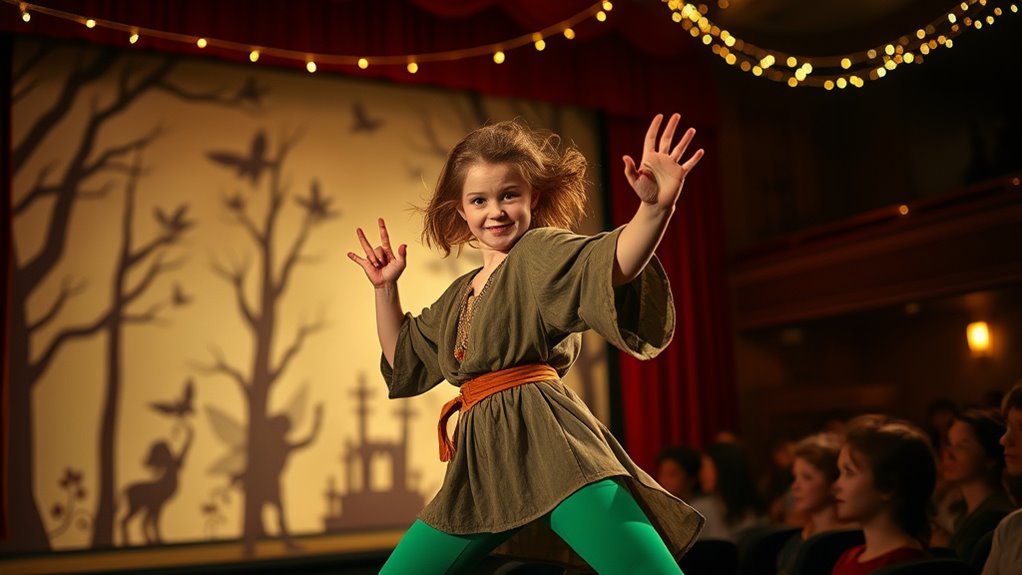
Why Is Peter Pan Played by a Woman?
You might notice Peter Pan is often played by a woman, and there’s a fascinating history behind this casting choice. In the early 20th century, labor laws limited child performers’ hours, making it difficult to cast actual boys for the role.
To avoid these restrictions and still capture Peter’s youthful innocence, theaters began casting adult women. Women bring a unique energy and emotional depth to the role, blending strength with whimsy.
This tradition has lasted over a century, shaping many iconic performances. If you want to uncover the rich history and evolving trends behind this choice, there’s a lot more to discover.
Why Women Traditionally Play Peter Pan

Though J.M. Barrie originally preferred a boy to play Peter Pan, the tradition of women playing the role began back in 1904. You see, English labor laws limited child actors’ hours, making casting a young boy complicated. Producer Charles Frohman suggested casting a woman—Maude Adams—both to avoid these restrictions and simplify scheduling.
Since then, women have often taken on Peter Pan, establishing a strong theatrical tradition. This casting choice wasn’t about gender but practicality and Barrie’s softened vision of the character. Over time, women brought a unique energy to Peter’s youthful, androgynous spirit, reinforcing the tradition.
How English Labor Laws Shaped This Tradition

You might not realize it, but English labor laws played a big role in who could perform as Peter Pan. Since kids under 14 couldn’t work late, producers cast adult women instead to keep the show running smoothly.
This solved scheduling problems and made rehearsals and performances much easier to manage.
Child Labor Restrictions
When English labor laws limited children under 14 from working past 9 p.m., theater productions had to get creative with casting Peter Pan. Child labor laws imposed strict performance restrictions on young actors, making it tough to schedule rehearsals and evening shows with boys in the lead.
By casting women as Peter Pan, producers sidestepped these limits, since adult actresses weren’t bound by the same rules. This practical workaround allowed theaters to comply with legal requirements while maintaining flexible performance times.
You’ll find that this solution wasn’t just about convenience; it shaped a lasting tradition. The initial need to navigate child labor laws directly influenced why women continue to play Peter Pan, blending legal compliance with theatrical creativity to keep the character alive on stage.
Scheduling Challenges Solved
Because English labor laws barred children under 14 from working past 9 p.m., theaters faced a tough scheduling dilemma for Peter Pan performances. If you were producing Peter Pan, you’d quickly realize that boys, often cast as Peter, couldn’t perform during late shows. This made scheduling evening performances tricky and limited the show’s run times.
By casting adult women in the role, producers cleverly bypassed these restrictions. Women could work late without legal issues, ensuring the show ran smoothly every night. This practical solution became standard, especially on Broadway, where consistent evening performances are essential.
Why the Tradition of Female Peter Pans Continues

Although casting a woman as Peter Pan might seem unusual at first, this tradition has deep roots in theatrical history and continues to thrive today. Sir James Barrie himself envisioned a female performer in the role, setting the stage for a longstanding custom.
When you think about casting women as Peter Pan, it’s clear this choice aligns perfectly with the character’s youthful innocence and spirit. Over the years, most adaptations have featured women, reinforcing this theatrical convention.
You’ll find that this tradition persists because it honors both historical precedent and the symbolic representation of childhood Peter Pan embodies. So, when you see a woman play Peter Pan, you’re witnessing a time-honored practice that captures the essence of the character in a unique and effective way.
Famous Women Who Made Peter Pan Iconic
Several women have made the role of Peter Pan unforgettable through their enchanting performances on stage. Mary Martin’s 1954 Broadway portrayal set a high standard, becoming one of the most iconic female interpretations of Peter Pan. You’ll also recognize Cathy Rigby, who brought Peter Pan to life multiple times since the 1970s, and Sandy Duncan, whose 1979 performance earned critical acclaim.
Charlotte d’Amboise continued this tradition in the 2000 Broadway revival, showing how women keep the character vibrant and compelling. Going back further, Maude Adams and Pauline Chase shaped the early legacy of women playing Peter Pan. These women didn’t just perform; they defined the role, proving why Peter Pan has become synonymous with powerful, enthralling female portrayals.
Modern Productions and Gender Casting Today
You’ll notice that modern productions mostly stick with women playing Peter Pan, keeping a tradition that highlights youth and whimsy.
But some performances are shaking things up by casting men or embracing gender fluidity onstage.
How audiences respond to these choices says a lot about changing views on gender in theater today.
Contemporary Casting Trends
While some contemporary productions experiment with male or gender-neutral casting, most modern adaptations of Peter Pan stick to the tradition of casting women in the role. You’ll find that this choice reflects both the character’s youthful innocence and the influence of iconic actresses like Mary Martin.
Though gender-blind casting appears occasionally, it remains rare, as directors and audiences often prefer the familiar portrayal.
| Production Type | Casting Approach | Reasoning |
|---|---|---|
| Traditional | Female actors | Upholds tradition, youthful role |
| Experimental | Male actors | Artistic reinterpretation |
| Gender-blind | Any gender | Focus on talent, versatility |
| Film adaptations | Mostly female | Audience expectations |
| Stage revivals | Predominantly female | Historical precedent |
You see, contemporary casting balances respect for tradition with occasional innovation.
Gender Fluidity Onstage
Although women traditionally play Peter Pan to honor early 20th-century theater practices, modern productions increasingly embrace gender fluidity by casting male actors or using gender-blind approaches. You’ll notice that casting choices today often challenge the longstanding theatrical tradition to explore new interpretations.
For instance, companies like the Royal Shakespeare Company have cast adult male actors as Peter Pan since the 1980s, reflecting evolving ideas about gender onstage. By focusing on the character’s youthful spirit instead of strict gender roles, directors open up creative possibilities that resonate with contemporary audiences.
When you consider these casting choices, you see how gender fluidity enriches the play’s meaning, allowing Peter Pan to embody a broader spectrum of identity and expression beyond traditional confines.
Audience Reception Today
Understanding how modern productions handle gender casting for Peter Pan helps reveal how audiences respond today. You’ll find that many appreciate the tradition of women playing Peter Pan, valuing its historical roots and charm. However, some challenge these gender norms, preferring male or gender-neutral portrayals that better fit contemporary views.
Audience reception balances respect for tradition with evolving ideas about gender roles in theater.
| Production Type | Gender Casting |
|---|---|
| Classic Theatre | Female Actors |
| NBC Live Broadcast | Female Actors |
| Experimental Theatre | Gender-Neutral |
| Community Plays | Mixed Casting |
| New Adaptations | Male or Female |
You’ll notice that tradition still holds strong but invites ongoing discussion about gender representation.
What It’s Like for Actors to Play Peter Pan
When you step into the role of Peter Pan, you have to capture the boundless energy and playful spirit of a young boy, a task that challenges even the most experienced actors. To play Peter convincingly, you’ll need to adopt childlike mannerisms, vocal tones, and physical agility. The role demands high stamina as you perform energetic movements and flying sequences while maintaining that youthful innocence.
Many actresses find this role uniquely rewarding, as it allows them to explore a character full of whimsy, bravery, and vulnerability. You’ll face emotional and physical challenges to keep the illusion of childhood alive on stage or screen, making the play both exhausting and exhilarating. Taking on Peter Pan means fully embracing the joyous, fearless spirit of eternal youth.
Frequently Asked Questions
Why Are the Lost Boys Only Boys?
The Lost Boys are only boys because they symbolize childhood innocence and boyhood camaraderie. You’ll see their all-male group highlights timeless childhood themes and maintains traditional gender roles important to the story’s original message.
Why Is Tiger Lily Controversial in Peter Pan?
Tiger Lily’s controversial because casting non-Native actresses in yellowface perpetuates harmful stereotypes and cultural appropriation.
You’ll find modern productions increasingly cast Native actresses or adjust the role to respect cultural sensitivity and avoid offense.
What Is Peter Pan Syndrome?
Peter Pan Syndrome means you struggle to grow up emotionally, avoiding responsibilities and commitments. You might feel stuck in childhood, craving eternal youth, acting immature, and depending on others instead of embracing adult roles and challenges.
What Is the Dark Theory of Peter Pan?
The dark theory of Peter Pan suggests you’re seeing a refusal to grow up, symbolizing repression of adult trauma and fear of mortality.
It highlights a struggle between clinging to innocence and facing harsh realities of life.
Conclusion
You might be surprised to learn that over 70% of major Peter Pan productions cast women in the role, highlighting how deeply this tradition is rooted in theater history. This choice isn’t just about costume or voice—it reflects a unique blend of practicality and artistry shaped by labor laws and storytelling needs.
So, when you watch Peter Pan, you’re experiencing a legacy that celebrates female talent and keeps the character’s timeless spirit alive. This enduring practice showcases why a woman plays Peter Pan, emphasizing the importance of tradition, performance, and theatrical history.